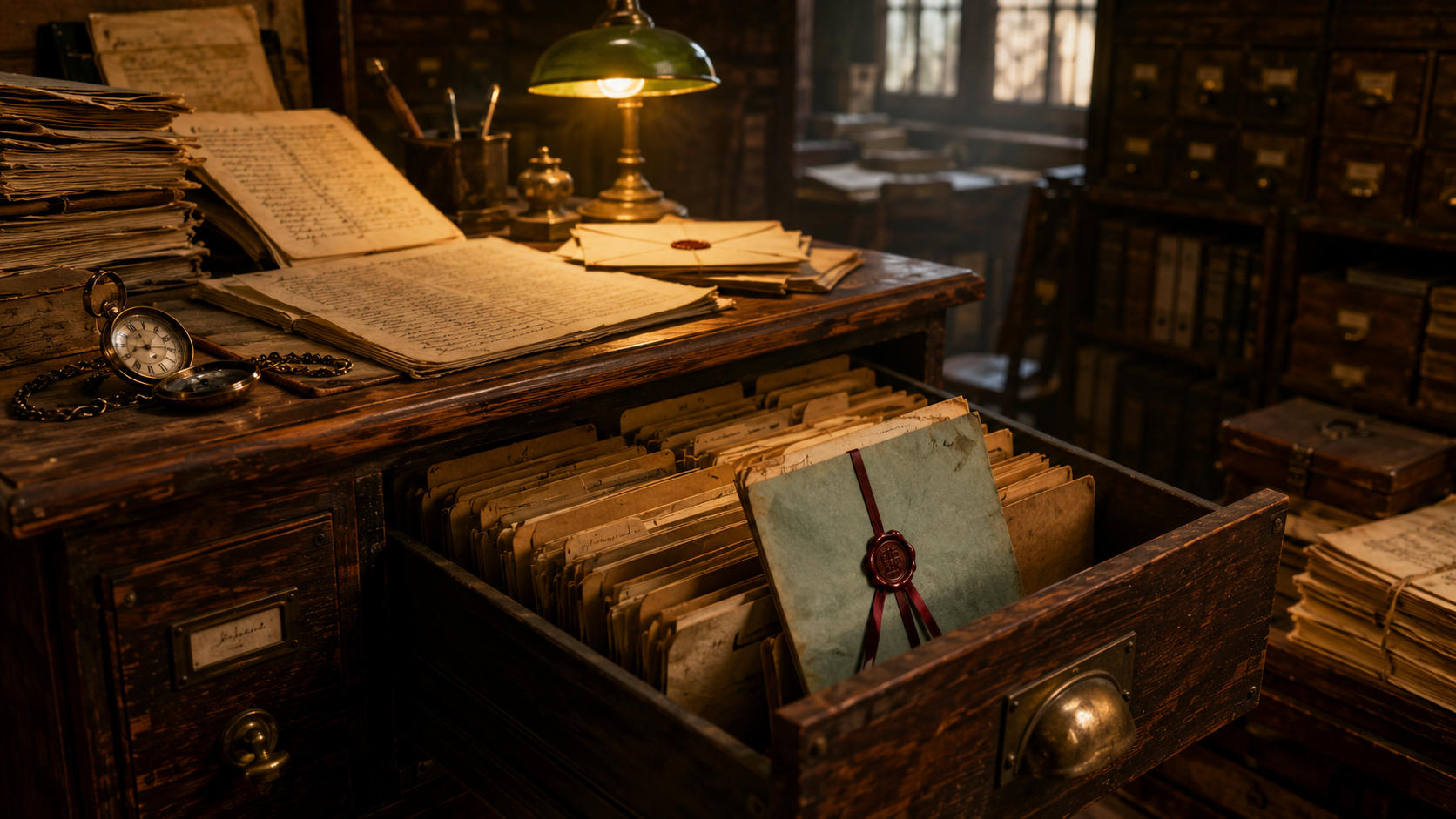
Misfiled Truths Can Change Everything
Some secrets do not need a locked room. They do not need a hidden passage, a buried box, or a sealed door. Sometimes, the most dangerous secret sits in a file drawer under the wrong name. That is the quiet power of misfiled truths. One wrong record can change a whole mystery. A date may not match, a name may appear in the wrong folder, a letter may sit among papers where it does not belong.
Small mistakes like these can open large questions.
In Nora Halewell’s world, archives do more than store the past. They protect it, shape it, and, at times, they hide it.
One misplaced file can make the truth begin to move again.
Why Misfiled Truths Make Strong Mystery Clues
A wrong record may look dull at first.
A file sits in the wrong box, a catalogue card shows the wrong date, a letter appears under the wrong family name.
Yet these small details create instant tension.
Was it a mistake? Did someone act in a hurry? Was the truth being hidden? Or did someone place the clue there on purpose?
That is why misfiled truths work so well in mystery fiction. They do not shout for attention. They wait for someone careful enough to notice.
For Nora Halewell, a wrong record is never just paperwork.
It is a warning.
The Mystery of a Name in the Wrong Place
Names matter in mysteries.
A name can connect families, reveal an heir, uncover a witness or it can prove that someone was present when they claimed to be far away.
So, when a name appears where it should not, the whole story begins to shift.
A servant’s name may turn up in a family file, a child may appear in an old estate ledger, a woman’s married name may hide who she used to be.
These details look small, but they can carry the weight of a whole mystery.
Nora understands this. She knows every name in an archive has a history. When one name refuses to fit, the past asks for a closer reading.
When Dates Refuse to Behave
Dates seem firm.
A birth date. A death date. A date on a letter. A date in a ledger.
In a mystery, though, one wrong date can cause real trouble.
A letter dated after someone supposedly left town creates a problem. A record dated before an event suggests someone changed the order of the story. Two documents with different dates for the same moment point to a gap.
That gap matters.
A wrong date can expose a lie, reveal a secret meeting or show that someone arranged the official story to protect a hidden truth.
This gives a simple archive clue real force.
Archives Are Not Always Neutral
Archives may look calm and truthful.
Files have labels. Papers sit in order. Records rest in neat rows. Everything seems official.
But people handle archives.
People make mistakes, they protect reputations, they hide shame and they choose which stories survive and which stories quietly disappear.
That is what makes archive mysteries so rich.
A neat file drawer can hide a lie, a careful label can make a false story look respectable, an official record can lead everyone away from the truth.
In Nora Halewell’s stories, the past does not always vanish.
Sometimes, someone simply puts it where no one thinks to look.
Why Nora Halewell Notices What Others Miss
Nora pays attention.
She does not need noise or drama to sense that something is wrong. A missing card can bother her, a crossed-out line can stop her, a folder that looks too clean can raise questions.
This makes her perfect for stories about misfiled truths.
Many people would glance at an old record and move on. Nora looks again. She asks why a document sits out of order. She wonders why one file feels too thin. She notices when a name, date, or place refuses to fit.
Her strength is not only courage.
It is patience.
She gives the past time to speak.
A Misfiled Letter Can Hold a Whole Story
Letters make wonderful mystery clues.
They carry voice, emotion, and intent. A letter may say too much, it may say too little, it may be signed, unsigned, torn, sealed, or tucked between unrelated papers.
A misfiled letter creates even more questions.
Who moved it? Why did it land in the wrong folder? Did someone want it lost? Or did someone hope the right person would find it later?
One letter can change how a reader sees a whole family.
It may reveal love, guilt, fear, betrayal, or protection.
That is why old documents carry such strong emotional force in mystery fiction. They do not only reveal facts. They reveal people.
Misfiled Truths and The Beauty of Slow-Burn Suspense
Misfiled truths create a gentle kind of suspense.
There may be no chase, no scream, no dramatic discovery in the first paragraph.
Instead, the tension builds slowly.
A record does not match, a name appears twice, a folder looks too new, a letter has already been opened, a date points to the wrong year.
Each detail feels small. Yet each one moves the reader closer to the truth.
This kind of mystery rewards attention. It invites the reader to investigate too. Soon, every file begins to look suspicious. Every label seems worth checking.
That is the pleasure of a Nora Halewell mystery.
The danger stays quiet, but it is very much alive.
When Someone Edits the Past
Archive-based mysteries often ask a chilling question.
What if someone edited the past?
Not the real past, of course. The record of the past.
A page can vanish, a file can gain a new name, a witness statement can move to the wrong drawer, a letter can end up under the wrong estate, a catalogue card can send future readers in the wrong direction.
This creates a very quiet kind of villainy.
It does not always look cruel: it may look careful, it may look polite, it may even look helpful.
Someone can hide the truth with a filing system.
That thought gives archive mysteries their strange power.
If the record lies, then everyone who trusts the record may believe the lie too.
Why Readers Love Archive Secrets
Archive secrets feel possible.
Many of us have opened an old box, read an old letter, or found a family paper that raised more questions than answers. The past often survives in scraps.
A photograph, a certificate, a note, a name in a ledger or a date that does not quite make sense.
This makes archive mysteries feel close to real life.
History does not always arrive as a grand discovery. Sometimes it sits folded in a drawer, sometimes it waits in a box, sometimes it hides under the wrong name.
Then the right person finds it.
Everything changes.
Misfiled Truths in Nora Halewell’s World
Nora Halewell’s mysteries suit this kind of discovery beautifully.
Her world has archives, clocks, vanished places, hidden documents, and time-slip secrets. Misfiled truths belong there because they can do so much at once.
They can create a clue, reveal a secret, connect the present to the past and they can make Nora question what everyone else has accepted as fact.
For Nora, the archive is never just a setting.
The drawers matter, the folders matter, the cards and labels matter too.
Every small object may form part of the puzzle.
The Quiet Power of One Wrong File
A mystery does not always need a dramatic clue.
Sometimes, one wrong file is enough.
One folder sits in the wrong drawer, a name appears where it should not, a date points to a hidden meeting. One letter survives because someone tried to lose it.
That is the beauty of misfiled truths.
They show that secrets do not always hide far away. Some survive in plain sight, disguised as ordinary mistakes.
A careful heroine knows better.
Nora Halewell knows better.
When she opens the wrong file, the truth may finally find its way out.
Leave a Reply