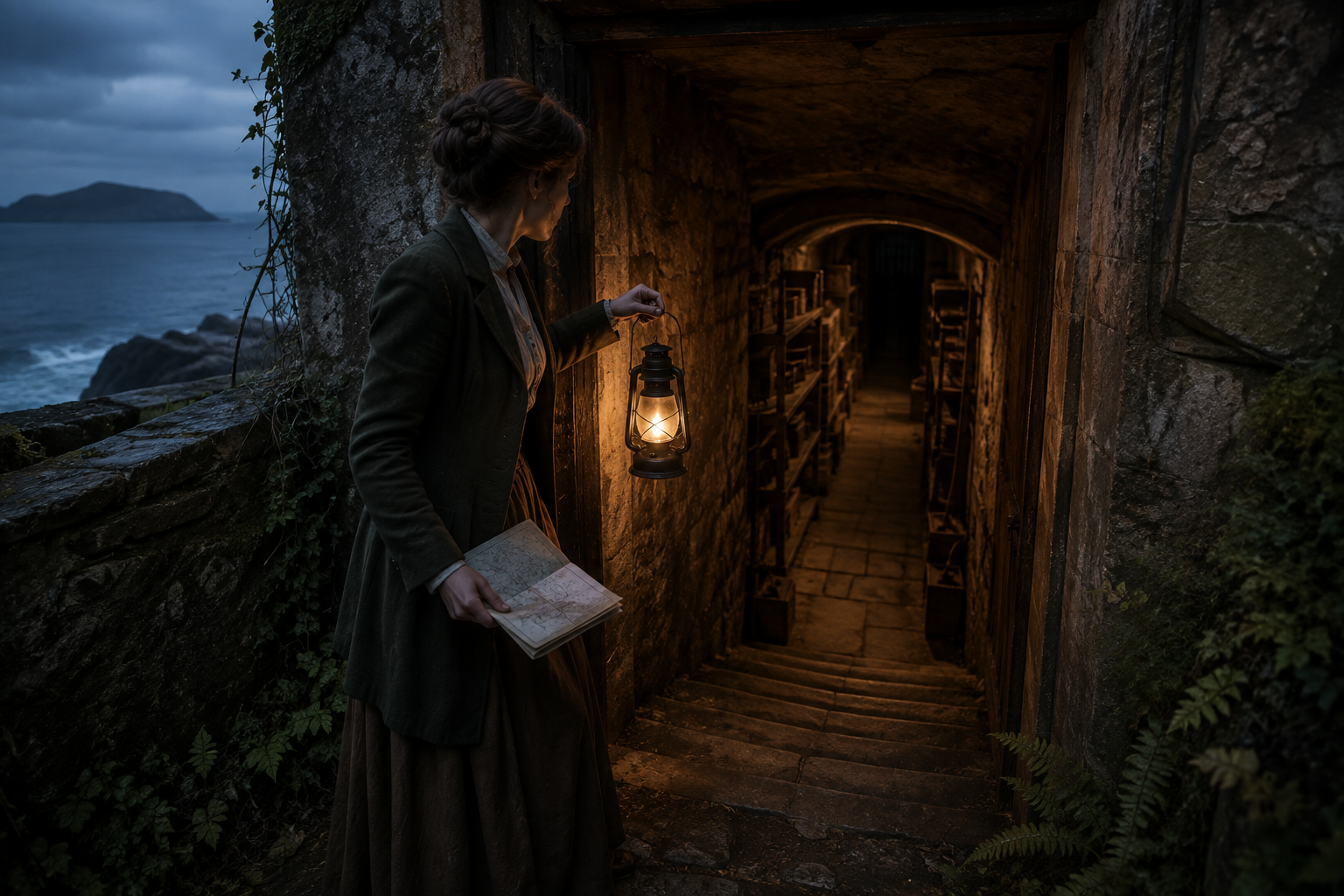
A heroine stands at the entrance to a dark passage beneath an old house. She has a lantern in one hand and a map in the other. Everything she has discovered tells her that answers may lie ahead, but those same clues warn her that continuing could be dangerous.
She is afraid.
And she goes anyway.
That moment captures something I find compelling about bravery in historical mystery heroines. Courage becomes far more interesting when a character feels fear rather than simply charging into danger without considering the consequences.
A brave heroine does not need to be fearless. In fact, fear can make her courage more believable because she understands what might happen and still decides that discovering the truth matters enough to continue.
Bravery Is Not the Absence of Fear
We sometimes describe courageous characters as though fear never touches them.
They walk into dark rooms without hesitation, confront dangerous suspects alone, and follow mysterious noises in the middle of the night. Nothing appears to unsettle them for long.
Yet real courage works differently.
Fear warns us that something matters. It tells us that we could lose something, suffer harm, or make a terrible mistake. Therefore, a character who recognises danger and continues despite it can feel much braver than one who never seems frightened at all.
That distinction matters when writing bravery in historical mystery heroines because historical women often face risks beyond the mystery itself. Their choices may threaten their reputations, security, employment, or relationships as well as their physical safety.
Continuing can require several different kinds of courage.
Historical Heroines Face More Than Physical Danger
A mystery heroine does not need to be running from a murderer to show bravery.
Sometimes she simply needs to ask the question everyone wants her to leave unanswered.
Historical settings make that especially powerful because social expectations can become obstacles of their own. A woman who challenges an influential man may face consequences even when she is correct. Someone who questions a respected family could find herself accused of gossip, disloyalty, or improper behaviour.
Money and position can also affect how freely she acts.
A wealthy woman may possess independence that a governess or servant does not. Meanwhile, a woman dependent upon an employer might recognise a lie but know that exposing it could cost her home and livelihood.
As a result, courage can appear in quieter forms.
Speaking becomes brave.
Refusing to accept an obvious injustice becomes brave.
Choosing to believe an overlooked witness can become brave too.
Nora Halewell Does Not Go Looking for Danger
Nora Halewell is a good example of the kind of courage I enjoy exploring.
She does not seek danger because she enjoys it. Nor does she enter a mystery assuming that nothing bad can happen to her.
Quite the opposite.
Nora understands that some doors should make her nervous.
She works with old books, records, maps, and archives, so her investigations often begin somewhere apparently safe. A strange detail in a document leads to another question, while an inconsistency in a map suggests that something has been forgotten or deliberately concealed.
At first, the danger may seem distant.
Then the past begins to reach into the present.
By the time Nora realises how serious the situation has become, walking away is no longer simple. Someone has been forgotten, a truth has been buried, or an injustice remains hidden because people accepted the official version of events.
Nora may wish she had never found the first clue.
However, she cannot pretend she did not see it.
Curiosity Can Become Responsibility
This is where Nora’s curiosity changes.
At the beginning of a mystery, she wants to understand something that does not make sense. Later, she often discovers that the unanswered question concerns real people whose stories have been altered, forgotten, or deliberately erased.
Curiosity then becomes responsibility.
That change is important because it gives Nora a reason to continue even when she feels frightened.
She is no longer searching merely because she wants an answer. Someone may need that answer.
Perhaps a name disappeared from a record. Maybe a map deliberately removed a settlement, or a document tells a version of history that contradicts what people remember.
Once Nora understands what has been lost, turning away becomes difficult.
Fear remains, but something else has become stronger.
The Dark Passage Is More Frightening When You Understand the Risk
Imagine Nora standing before a hidden passage.
The sensible choice may seem obvious.
Do not enter.
The passage is dark, the structure is old, and Nora has no guarantee that it leads anywhere safe. Worse still, she may already suspect that someone does not want her investigating it.
A fearless heroine might simply lift her lantern and march inside.
Nora would probably hesitate.
She might listen first. Perhaps she checks the map again, considers whether anyone knows where she is, and wonders whether she has made a terrible mistake.
Then she enters.
That hesitation does not weaken the scene. Instead, it strengthens it because the reader understands that Nora knows she has reason to be afraid.
Her courage lies in the decision that follows.
Courage Can Mean Admitting You Need Help
Another interesting aspect of bravery in historical mystery heroines is the willingness to accept help.
Fiction sometimes treats independence as though it requires doing everything alone. A heroine proves her strength by refusing assistance, keeping dangerous discoveries secret, and confronting threats without telling anyone where she is going.
That approach can certainly create suspense, but it is not the only way to show courage.
Asking for help can require humility.
Trusting another person with important information can feel risky, especially if the heroine has previously been betrayed or dismissed. Likewise, admitting that a situation has become too dangerous to handle alone requires her to recognise her limits.
Nora gradually learns that uncovering the past does not mean she must carry every burden herself.
Other people may possess knowledge she lacks.
Listening to them can move the investigation forward.
Nora’s Strength Is Also Her Vulnerability
Every useful character strength can create problems when pushed too far.
Nora‘s determination helps her uncover truths that other people overlook, but that same determination can lead her deeper into danger. Her curiosity makes her a strong investigator, yet it can also make unanswered questions almost impossible for her to ignore.
Once something does not fit, she wants to know why.
That quality becomes particularly dangerous when someone else desperately wants the answer to remain hidden.
However, removing Nora’s fear would remove much of the tension from those moments. If she never worried about the consequences, her determination would simply become recklessness.
Instead, she must repeatedly decide whether the truth justifies another step.
Sometimes it does.
At other times, she needs to change her approach.
That tension allows courage to become part of her character development rather than merely a convenient personality trait.
Arabella Grey Shows Courage Differently
Arabella Grey’s courage often emerges through confrontation.
She watches people closely, and once she recognises that something is wrong, she can be remarkably difficult to silence. Social status does not automatically impress her, while respectability does not convince her that someone must be innocent.
Yet Arabella also faces consequences for challenging people.
A direct accusation can close doors. Asking the wrong question may alert a suspect, while pushing too hard can place another person at risk.
Therefore, Arabella must learn when to confront and when to wait.
Her courage lies not only in speaking but also in knowing when the truth needs patience.
Clara Everhart Faces the Fear of Not Understanding
Clara’s mysteries bring a different kind of uncertainty.
Sometimes the evidence challenges her understanding of what should be possible. A memory, object, or connection may refuse to fit into the explanation she wants to accept.
That creates its own fear.
Physical danger is frightening, but so is realising that your understanding of reality may be incomplete.
Clara must continue asking questions even when the answers unsettle her. Instead of running from what she cannot explain, she learns to examine it carefully.
Her courage therefore grows through uncertainty.
She does not always know where the next clue will lead, yet she keeps searching.
Different Heroines Need Different Kinds of Courage
This is why I enjoy exploring bravery in historical mystery heroines across different series.
Arabella may need the courage to confront someone powerful.
Clara may need the courage to accept something she cannot yet explain.
Nora may need the courage to follow a forgotten trail into an uncertain place.
Their fears differ because their personalities and mysteries differ.
However, the principle remains the same.
Courage becomes meaningful when something is at stake.
Fear Can Help a Heroine Make Better Decisions
Fear is not always an enemy.
Sometimes it tells a heroine to look more carefully.
A nervous feeling may make Nora check an old map again before entering a passage. Arabella might recognise that a suspect’s sudden friendliness should make her cautious, while Clara may hesitate before trusting a connection that appears too convenient.
Those moments allow fear to become information rather than weakness.
A strong heroine can listen to that warning without allowing it to control her.
She prepares.
She thinks.
Then she decides.
That process often creates a more believable investigator because bravery and good judgement can exist together.
The Quietest Courage Can Matter Most
Not every courageous moment needs a dramatic confrontation.
Some of the strongest scenes occur when nobody else recognises what the heroine has risked.
A woman quietly tells the truth after years of silence.
Someone hands over a document that could threaten her family’s reputation.
A servant contradicts her employer because an innocent person may otherwise suffer.
Nora enters a forgotten place because a person erased from history deserves to be remembered.
These actions may not involve weapons, chases, or dramatic rescues, yet they can carry enormous emotional weight.
Historical mysteries work especially well with this quieter courage because so many secrets survive through silence.
Breaking that silence can be dangerous.
Why Fear Makes Mystery Heroines Stronger
Readers do not need heroines who always know what to do.
Often, we connect more deeply with characters who doubt themselves, make mistakes, feel frightened, and still find a way forward.
That is why bravery in historical mystery heroines should not require the removal of fear.
Fear gives the decision weight.
When Nora raises her lantern before entering a dark passage, the important thing is not that she suddenly stops being afraid. She may still want to turn around. Every sensible instinct may tell her that whatever lies ahead could change everything.
Yet somewhere beyond that darkness is a truth somebody tried to hide.
So she tightens her grip on the map.
She lifts the lantern.
And she takes the next step.
Because bravery is not always walking without fear.
Sometimes it is simply refusing to let fear decide where the story ends.


