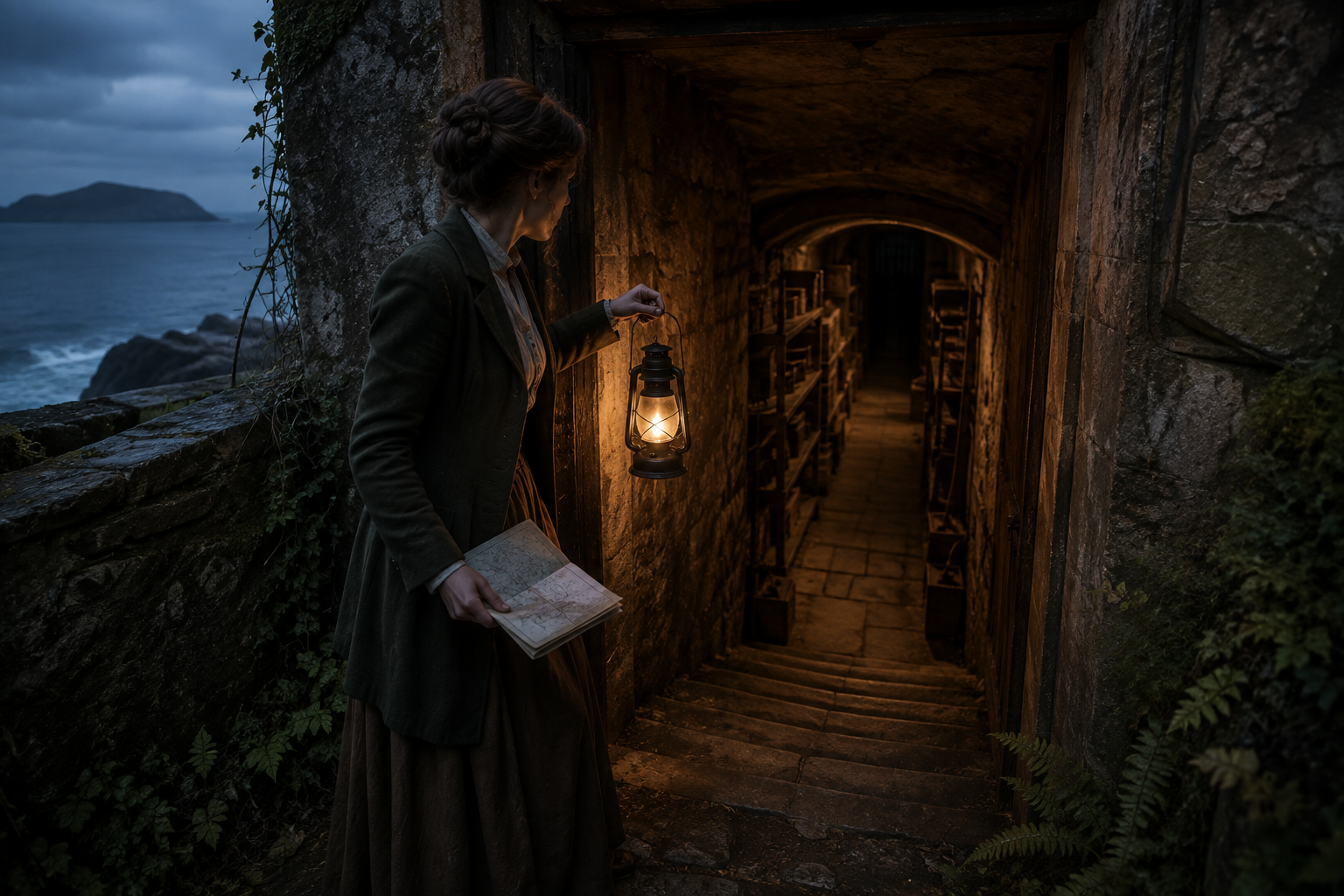
Courage in a mystery does not always arrive with a dramatic confrontation. Sometimes it appears in a woman who asks one more question when everyone else wants the matter closed. At other times, it is found in the choice to enter a dark room, challenge an accepted story, or keep searching after fear has already provided every reason to stop. That quieter bravery is at the heart of courage in historical mystery heroines.
Arabella Grey, Clara Everhart, and Nora Halewell are very different women. However, each one shows that courage does not need to be loud to be convincing.
Their bravery grows from patience, curiosity, loyalty, and the refusal to look away.
Why Courage in Historical Mystery Heroines Feels Different
Historical mystery settings often place women inside strict social rules.
A heroine may know that something is wrong, yet she cannot simply force her way into every room or demand answers from anyone she chooses. Instead, she must consider reputation, class, family influence, and the expectations placed upon women.
Those limits create a different kind of tension.
Bravery becomes less about physical action and more about persistence.
A woman may need courage to contradict a respected gentleman. Another might risk her position by asking about a missing document. Someone else could continue an investigation even after a household has made it clear that her questions are unwelcome.
This is why courage in historical mystery heroines can be so compelling.
Their bravery often works quietly against the rules of the world around them.
Arabella Grey: Courage Through Steadiness
Arabella Grey rarely needs to dominate a room.
Her strength lies in remaining calm long enough to notice what everyone else is trying to hide.
A respectable family may insist that an explanation is obvious. Servants might repeat the same account, while influential relatives expect the matter to end quickly.
Arabella does not argue simply for the sake of it.
Instead, she watches.
Perhaps the timing does not fit. A witness may answer too quickly, or a familiar routine may suddenly change.
Once Arabella sees the inconsistency, she keeps following it.
That persistence is one of her strongest forms of courage.
She understands that powerful people may prefer silence. Nevertheless, she does not confuse social confidence with truth.
It Takes Courage to Distrust the Easy Answer
Mysteries often offer an obvious suspect early.
The governess had access. A servant was seen nearby. An outsider behaved strangely.
Accepting that explanation would make life easier for everyone.
Arabella’s courage appears in her refusal to do so.
She asks who benefits from the accusation and why suspicion settled so quickly. Moreover, she notices whether the evidence truly points toward guilt or merely toward someone with less power.
This approach is not dramatic.
Yet it can be dangerous.
Challenging a convenient solution means challenging the people who created it.
For Arabella, quiet courage means trusting observation over reputation.
Clara Everhart: Courage Through Questioning
Clara Everhart faces a different kind of fear.
Her mysteries involve history, science, memory, invention, and events that do not always behave as they should.
A strange document may contradict the official record. An invention might appear too early, while a familiar name can surface in the wrong century.
Clara’s courage begins when she refuses to dismiss the impossible.
That does not mean she believes every strange explanation.
Quite the opposite.
She questions more carefully.
When accepted history no longer fits the evidence, Clara is willing to consider that the accepted version may be incomplete.
Knowledge Can Be Frightening
Discovery is often treated as exciting.
However, new knowledge can also be deeply unsettling.
What happens if a scientific breakthrough should never have existed? Should dangerous information be preserved simply because it is true?
Clara’s mysteries can place her in situations where learning more may make the problem worse.
Still, she continues.
Her bravery does not come from being certain that everything will end well.
Instead, it comes from accepting that uncertainty cannot be solved by pretending the evidence does not exist.
That makes her courage intellectual as well as emotional.
Clara Must Also Risk Being Wrong
Questioning history carries another danger.
Clara may be mistaken.
She could misread a document, trust the wrong theory, or assume that one impossible clue explains too much.
That possibility matters.
True courage is not the same as absolute confidence.
Clara must be willing to investigate while knowing that her own interpretation may fail.
As a result, she keeps testing her assumptions.
This is another strong example of courage in historical mystery heroines because bravery here includes humility.
She does not only ask, “What if I am right?”
Clara must also ask, “What if I am wrong?”
Nora Halewell: Courage Through Reluctance
Nora Halewell may show quiet courage most clearly because she often understands exactly why she should walk away.
An old archive is supposed to be safe.
Maps should be records. Catalog cards should be dull, while forgotten documents should remain quietly forgotten.
Nora knows better.
A missing file can change the meaning of an entire collection. Likewise, an altered map may expose a decision someone intended to hide.
Her discoveries often begin with something small.
Then the implications grow.
Nora may be frightened long before she reaches the most dangerous part of the mystery.
Still, she continues.
Fear Does Not Cancel Bravery
Readers sometimes imagine a courageous heroine as someone who rarely feels afraid.
Nora challenges that idea.
She may hesitate before entering a hidden room or following a suspicious trail. Furthermore, she often considers every sensible reason to stop.
That hesitation does not weaken her.
It makes the next step more meaningful.
Bravery becomes a choice rather than a personality trait.
Nora moves forward because unanswered questions matter to her.
A forgotten person, erased settlement, or deliberately hidden record deserves to be found.
Her fear remains present, yet it does not make the final decision.
Courage in Historical Mystery Heroines Often Protects Others
Another reason quiet courage works so well in historical mysteries is that the heroine is often acting for someone who has less power.
Arabella may defend the person everyone has already decided to blame.
Clara could protect knowledge from being misused, while Nora may uncover the story of someone history deliberately removed.
Their investigations therefore become more than puzzles.
Truth has consequences.
Solving the mystery may restore a reputation, expose wrongdoing, or give a forgotten person back a place in the record.
That responsibility makes the danger more personal.
Speaking Can Be an Act of Courage
Modern readers may underestimate how risky a direct question could be in some historical settings.
Class and gender influenced who was expected to speak.
A woman who challenged an influential man could be described as rude or unstable. Likewise, a servant who accused an employer might lose more than a position.
Because of this, speech itself can carry danger.
Arabella understands when politeness is being used to shut down an investigation.
Clara recognizes when authority is hiding behind certainty.
Meanwhile, Nora sees how official records can silence people without anyone needing to speak at all.
Each heroine must decide when silence is wise and when it becomes cooperation with the lie.
Courage Can Look Like Patience
Mystery fiction often rewards action.
Yet patience can require just as much courage.
A heroine may know that pushing too hard will make a witness retreat. Therefore, she waits.
Someone else may recognize that an accusation cannot yet be proved. Rather than rushing forward, she gathers one more piece of evidence.
This restraint matters.
Arabella is particularly skilled at allowing people to reveal themselves.
Nora may spend hours following the history of one missing record.
Clara can test a theory repeatedly before accepting it.
Their courage includes the ability to resist the easy drama of a premature conclusion.
Courage Can Look Like Changing Your Mind
A detective often begins with a theory.
Sometimes that theory is wrong.
Admitting the mistake can be difficult, especially after other people have accepted the conclusion.
Strong historical mystery heroines must be willing to change direction.
Arabella may realize that the nervous witness she suspected is hiding a different secret.
Clara can discover that the impossible explanation is not the correct one after all.
Nora might learn that a missing document was removed for reasons she did not expect.
The search for truth demands flexibility.
Courage therefore includes letting go of a comforting answer.
Quiet Bravery Creates Stronger Characters
A heroine who never doubts, hesitates, or fears anything can feel distant.
By contrast, quiet courage allows readers to understand the cost of each decision.
Arabella knows that confronting a respected household can make her unwelcome.
Clara understands that some discoveries change the person who finds them.
Nora recognizes danger and would often prefer not to enter it.
Their bravery feels believable because fear is not missing.
It is simply not in charge.
Why Readers Connect With This Kind of Courage
Many readers will never chase a suspect through a dark mansion.
Still, they understand what it means to speak when remaining silent would be easier.
People know the feeling of questioning a confident explanation or continuing with something difficult despite uncertainty.
That is why quiet courage can feel more personal than dramatic heroics.
It reflects ordinary bravery.
A person notices something is wrong.
She considers looking away.
Then she chooses not to.
Three Heroines, Three Forms of Courage
Arabella Grey’s courage is steady.
She refuses to let status, manners, or appearances replace evidence.
Clara Everhart’s bravery is curious.
She questions history, science, and even her own assumptions when the facts demand it.
Nora Halewell’s courage is reluctant but persistent.
She may fear the next discovery, yet she cannot leave an erased truth buried once she knows it is there.
These differences help each series feel distinct.
At the same time, all three women share the same essential strength.
They continue searching.
The Courage to Look Again
A good mystery often depends on the moment when the investigator decides the first explanation is not enough.
Someone else may have accepted it.
The household might want the matter finished, while the official record appears complete.
Still, something does not fit.
Quiet courage begins there.
Arabella looks again at the people.
Clara examines the timeline.
Nora returns to the records.
None of them needs to be fearless.
They only need enough courage for the next question.
That may be the most powerful thing about courage in historical mystery heroines.
Their bravery is not built on never being afraid.
It is built on deciding that the truth matters more than the comfort of looking away.