Author: admin

  • Three Historical Mystery Heroines and the Different Ways They Find the Truth

    Three Historical Mystery Heroines and the Different Ways They Find the Truth

    Historical mysteries often begin with the same problem. Something has been hidden, altered, or carefully forgotten. Yet the path to the truth can look very different depending on the woman following the clues. The three historical mystery heroines in Mandy Ludick’s mystery series each bring a distinct strength to an investigation.

    Arabella Grey studies people and their habits. Clara Everhart questions accepted history and tests what seems impossible. Nora Halewell searches archives, maps, and forgotten records for what someone hoped would remain buried.

    Their worlds are different. However, each heroine understands that the truth rarely announces itself. Instead, it waits in a misplaced object, a strange date, a rehearsed answer, or a document filed under the wrong name.

    Why Historical Mystery Heroines Need More Than Courage

    Courage matters in any mystery. Even so, courage alone does not solve a case. A strong investigator must know where to look. She must also understand what a clue means within its own time and setting.

    Modern technology cannot help Arabella test a witness’s claim. Clara cannot simply search the internet for an altered historical event. Likewise, Nora cannot assume that every official record is complete or honest.

    Because of these limits, historical mystery heroines must rely on patience, knowledge, and close observation.

    They also face social rules that shape how they investigate. People may dismiss their questions, restrict their access, or expect them to remain silent. As a result, each discovery requires both intelligence and tact.

    That tension gives historical mysteries much of their appeal. Readers are not only watching a heroine solve a puzzle. They are also watching her find a way to be heard.

    Arabella Grey Finds Truth in Human Behavior

    Arabella Grey solves mysteries by noticing what other people overlook.

    She pays attention to routine, posture, tone, and silence. A witness may offer a perfect answer, but Arabella watches what happens before and after the words are spoken.

    Perhaps a teacup remains untouched during a difficult conversation. A chair may be angled away from the door. Someone might avoid using a particular name. Another person may repeat a phrase that sounds too polished to be natural.

    None of these details proves guilt on its own. Together, however, they reveal pressure, fear, and hidden loyalties.

    Arabella’s strength lies in her patience. She does not rush to fill every silence. Instead, she allows people to reveal themselves.

    This method suits the Victorian households and villages she enters. Many of the people around her value respectability above honesty. They may not tell direct lies, yet they often hide behind manners, rank, and carefully chosen words.

    Arabella understands that appearance can become a form of protection. Therefore, she looks beyond what a household says about itself.

    Her investigations often begin with one quiet question: does this explanation match the way these people actually live?

    When the answer is no, Arabella keeps looking.

    Clara Everhart Finds Truth by Challenging History

    Clara Everhart investigates a different kind of mystery.

    Her cases involve lost manuscripts, dangerous inventions, memory, science, and events that do not fit the accepted version of history. Because time itself can become part of the puzzle, Clara must question facts that others treat as settled.

    A date may be wrong. A document may describe an event before it happened. An invention might appear decades too early. Even more troubling, Clara may find evidence connected to her own life in a period she has never visited.

    These clues force her to think beyond ordinary cause and effect.

    Still, Clara does not abandon logic. She studies patterns, compares records, and tests each theory against the evidence. The mystery may be impossible, but her reasoning remains disciplined.

    That balance makes her one of the most unusual historical mystery heroines. She is willing to accept that history may have changed, although she refuses to accept an explanation simply because it sounds dramatic.

    Clara also understands that official history is incomplete.

    Books preserve major events, but personal objects often preserve the truth. A diary may record fear that never reached the public record. A letter can expose doubt behind a famous decision. Meanwhile, a small handwritten correction may challenge an entire accepted story.

    For Clara, the past is not a fixed display behind glass. It is a living trail of choices, omissions, and consequences.

    Her central question is simple but powerful: what happened before history decided what to remember?

    Nora Halewell Finds Truth in Records and Omissions

    Nora Halewell is drawn to evidence that looks dull to almost everyone else.

    Archive boxes, catalog cards, survey maps, old labels, and official files may appear harmless. Yet Nora knows that records can be manipulated just as easily as witnesses.

    A missing file may be an accident. On the other hand, it may show that someone wanted a name forgotten.

    An incorrect date might be a copying error. However, it could also reveal that an event happened at a different time than everyone claims.

    Nora studies not only what survives but also what is absent.

    This becomes especially important when she examines maps. Maps appear objective because they use measurements, lines, and labels. Nevertheless, every map reflects choices about land, ownership, borders, and importance.

    A settlement left off a map has not stopped existing. Instead, someone has decided that it should not be seen.

    Nora’s cases often begin with these quiet forms of erasure. She finds places removed from official records, people filed under the wrong name, or documents hidden inside unrelated collections.

    Unlike Arabella, Nora does not begin by reading a room. Unlike Clara, she does not begin by challenging the laws of time. Instead, she asks who created the record, who controlled it, and who benefited from the way it was preserved.

    Her courage is often reluctant. She would prefer a clear archive and an orderly explanation. Yet once she sees that someone has been erased, she cannot ignore it.

    That choice makes Nora’s investigations deeply personal. She is not simply solving a puzzle. She is restoring something that was deliberately taken away.

    Three Historical Mystery Heroines, Three Kinds of Evidence

    Arabella, Clara, and Nora all seek the truth, but they trust different kinds of clues.

    Arabella reads behavior.

    Clara tests history.

    Nora investigates records.

    These methods often overlap. A document can contain a lie, while a witness can reveal a missing piece of history. Similarly, a map may expose a motive that changes how a character behaves.

    Even so, each heroine has a natural starting point.

    Arabella asks, “What are these people not saying?”

    Clara asks, “What if the accepted version is wrong?”

    Nora asks, “Who decided what should be preserved?”

    Their questions shape the mood of each series. Arabella’s mysteries feel intimate and socially tense. Clara’s cases carry the danger of impossible knowledge. Nora’s investigations unfold through archives, hidden places, and the slow recovery of lost truths.

    Why Readers Connect with Different Heroines

    Readers often choose a favorite investigator because her way of thinking feels familiar.

    Some readers love Arabella’s restraint. They enjoy watching small details gather meaning until a polished explanation begins to fall apart.

    Others prefer Clara’s curiosity. They want mysteries that combine history with science, invention, and impossible questions.

    Meanwhile, archive lovers may feel most at home with Nora. Her world rewards readers who understand the thrill of an old label, a forgotten drawer, or a map that does not match the landscape.

    A favorite heroine may also reflect the kind of truth a reader values most.

    Arabella proves that people reveal more than they intend.

    Clara shows that accepted knowledge should still be questioned.

    Nora reminds us that absence can be evidence.

    Together, these historical mystery heroines offer three different ways to enter a mystery and three different reasons to keep turning the pages.

    Which Historical Mystery Heroine Would You Follow?

    Every mystery begins with something that does not fit.

    Arabella Grey notices the pause before an answer.

    Clara Everhart recognizes that the timeline is impossible.

    Nora Halewell discovers that an important record is missing.

    From that first clue, each woman follows a different path. Yet all three understand the same essential truth: secrets survive because most people accept the easiest explanation.

    These heroines do not.

    They observe, question, compare, and continue searching. Most importantly, they refuse to look away simply because the truth has been made inconvenient.

    Which investigator would you trust?

    Would you follow Arabella into a respectable Victorian household, Clara into a century where history has shifted, or Nora into an archive where someone has carefully removed the truth?

    Whichever path you choose, a mystery is already waiting.
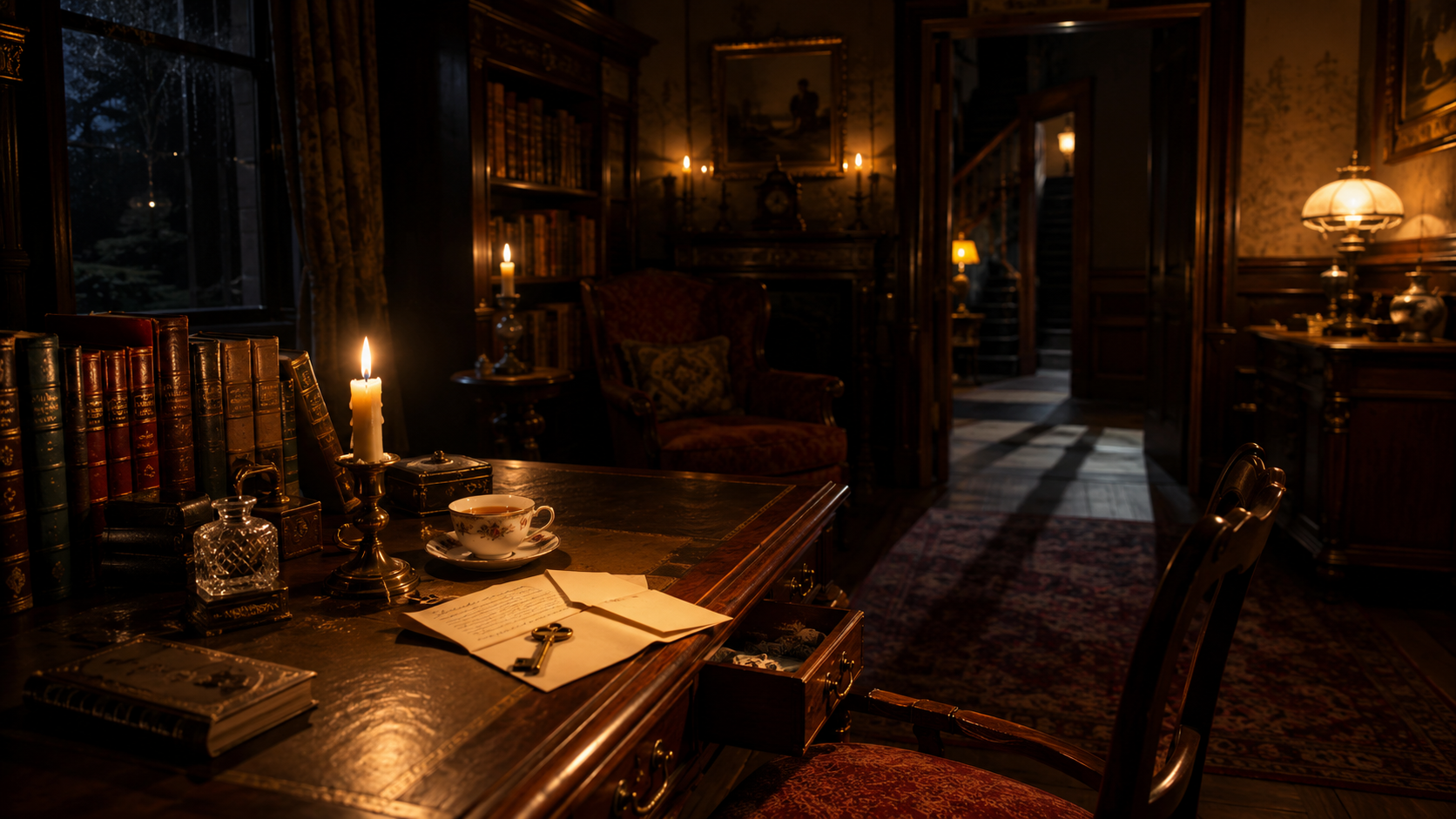
  • Candlelight and Contradictions: How Night Scenes Build Cozy Mystery Suspense

    Candlelight and Contradictions: How Night Scenes Build Cozy Mystery Suspense

    Some mystery scenes do not need thunder, screams, or a chase through the dark. They only need a candle burning low. A quiet room after midnight can do more for tension than a dramatic confrontation. The house settles. Footsteps sound sharper. Shadows stretch across the wallpaper, and ordinary objects begin to look slightly wrong.

    That is where cozy mystery suspense often works best. It grows slowly. It asks the reader to notice the teacup left untouched, the door standing open, the letter placed too carefully on the desk.

    Night does not create the mystery on its own. It simply makes every small detail harder to ignore.

    Why Night Scenes Create Cozy Mystery Suspense

    Night changes the mood of a cozy mystery. During the day, a village or manor house may feel safe. People move through routines. Servants carry trays. Visitors call. Letters arrive, and conversations happen under the rules of polite society.

    After dark, those rules soften.

    A hallway becomes more suspicious. A library feels less like a place of learning and more like a place of secrets. Even a familiar staircase can seem to hold its breath.

    This shift helps build cozy mystery suspense because the setting remains familiar, but the feeling changes. Readers know the house, garden, archive, or village lane. Yet under lamplight, the same place begins to feel uncertain.

    A cozy mystery does not need to become harsh to become tense. It only needs to make comfort feel fragile.

    Candlelight Makes Every Detail Matter

    Candlelight is perfect for mystery fiction because it reveals and hides at the same time.

    A candle may show the edge of a folded note while leaving the rest of the room in shadow. It may catch the shine of a key, the rim of a teacup, or the brass face of a clock. At the same time, it can conceal a person standing just beyond the glow.

    That balance creates tension.

    Readers can see enough to wonder, but not enough to feel certain. The light is warm, yet the uncertainty is sharp. This is one reason candlelit scenes suit cozy mysteries so well. They keep the atmosphere beautiful while letting suspicion grow.

    A candle also gives the sleuth another clue. If it has burned too low, someone stayed longer than they claimed. When fresh wax appears in an unused room, the story changes. A flame in a window may signal a secret meeting, or it may warn that someone has returned.

    Small light can expose a large lie.

    Contradictions Build the Strongest Mystery Scenes

    A contradiction is one of the best tools for suspense.

    Someone says the library was empty, but the fire was still warm. A guest claims to have gone to bed early, yet a candle was seen moving near the stairs. The housekeeper insists that no one entered the study, although the ink on the desk has not dried.

    These small conflicts make readers lean closer.

    Cozy mystery suspense often depends on this kind of mismatch. The official story says one thing. The physical evidence says another. The sleuth must decide which detail refuses to fit.

    That is more satisfying than simple alarm. A contradiction gives the reader a puzzle. It also creates unease because the truth has started to press through the surface.

    A well-placed contradiction does not need to explain itself at once. It only needs to disturb the scene.

    Cozy Mystery Suspense and the Power of Shadows

    Shadows can make familiar objects feel strange.

    A chair becomes a figure. A curtain looks like movement. A coat hanging on a peg seems too much like a person waiting in the dark. These moments do not need to be supernatural. They work because the reader knows how easily the mind fills in what it cannot see.

    In cozy mysteries, shadows should add mood without taking over the story.

    The real danger usually lies in human secrets, not in the darkness itself. A shadow may hide a suspect, but it may also hide a clue. The sleuth needs calm eyes. She cannot trust fear alone.

    This creates a lovely contrast. Other characters may rush to conclusions, while the sleuth studies the room. She notices the candle, the footprint, the moved chair, and the page that should not be there.

    The shadow sets the mood, but the detail solves the mystery.

    Night Makes Sounds More Suspicious

    At night, small sounds become larger.

    A floorboard creaks. A clock ticks too loudly. Rain taps the window. Somewhere beyond the door, a soft step pauses and then moves away.

    These sounds build suspense because they suggest presence.

    Someone may be awake who should be asleep. Another person may be moving through the house unseen. A door may open in a corridor that everyone claimed was locked.

    Sound is useful in cozy mystery suspense because it can stay gentle while still feeling tense. A footstep is not violent. A whisper is not dramatic. Yet both can change the whole mood of a scene.

    A sleuth may not know who made the sound at first. Still, she knows the house has just contradicted someone.

    The Midnight Room

    Every good cozy mystery needs a room that feels different after dark.

    It might be a library, attic, study, archive, conservatory, or sitting room. During the day, people pass through it easily. At night, the same room becomes charged with meaning.

    A desk drawer may be slightly open. One book may stand forward on the shelf. A letter may rest where no one admits leaving it. Perhaps the clock has stopped, or the candle has burned almost to the socket.

    The room becomes a puzzle box.

    This kind of scene works because the reader is invited to inspect it with the sleuth. Nothing needs to happen quickly. Suspense grows from attention. The longer the sleuth looks, the more the room begins to speak.

    Why Cozy Mystery Suspense Should Not Feel Too Heavy

    Cozy mystery suspense needs balance.

    The story should feel tense, but not bleak. It should keep readers curious without draining the warmth that makes cozy fiction appealing. Candlelight, tea, old houses, gardens, libraries, and quiet heroines can all create comfort. The secret lies in letting that comfort tremble.

    A cozy mystery can be eerie without becoming grim.

    The reader may feel a chill when a door opens at midnight, but the story still offers structure, intelligence, and eventual justice. That matters. Cozy mysteries invite readers into danger, but they also promise that truth can be found.

    Night scenes help with this because they create atmosphere without needing constant shock. The mood deepens, the clues sharpen, and the reader keeps turning pages.

    How Heroines Use the Dark Differently

    Different sleuths read night scenes in different ways.

    Arabella Grey might notice household routine. She would ask why a candle burned in a room no one was meant to use. A cold teacup, a shifted chair, or a servant’s hesitation would matter to her.

    Clara Everhart would question time. A clock at the wrong hour, a manuscript opened after dark, or a brass mechanism still warm to the touch could point toward something stranger than a simple lie.

    Nora Halewell would follow records and places. A file removed at night, a light in an archive window, or a map disturbed on a desk would draw her deeper into the truth.

    Each heroine sees something different, but all three understand one thing. Darkness does not hide everything. Sometimes it reveals what daylight made easy to ignore.

    The Best Night Clues Feel Ordinary

    A night clue does not need to be dramatic. A candle stub can matter. So can a warm hearth, a missing key, a damp hem, or a letter left on a chair. These objects feel ordinary, which makes them perfect for cozy mystery suspense.

    Readers enjoy these clues because they feel fair. The evidence sits in the scene, waiting for someone to notice it. When the reveal comes later, the reader can look back and see how the truth was present all along.

    The trick is to make the ordinary object feel slightly wrong.

    A cup belongs in the room, but not on that table. A key belongs on the hook, but not in that hand. A letter belongs in the drawer, but not half-burned in the grate.

    Suspense begins when one small thing refuses to behave.

    Candlelight, Contradictions, and the Reader’s Curiosity

    Cozy mystery suspense works best when it makes the reader ask questions.

    Who lit the candle?
    Why was the study open?
    Which person moved through the hall after midnight?
    What did the witness hear, and what did they choose not to say?

    These questions keep the story alive. They pull the reader forward without needing to rush. A good cozy mystery trusts curiosity. It lets the reader sit with the scene, test the details, and feel the quiet pressure of an answer nearby.

    Candlelight gives the mood. Contradictions give the puzzle. Together, they create the kind of suspense that feels intimate, atmospheric, and hard to put down.

    Final Thoughts

    Cozy mystery suspense does not need to shout.

    It can begin with a candle, a shadow, a sound in the hall, or a room that looks almost right. Night scenes work because they make familiar places feel uncertain. They let small clues shine, and they give contradictions room to breathe.

    A candlelit room can be beautiful.

    It can also be full of secrets.

    That is the charm of cozy mystery fiction. The danger may be quiet, but the truth is waiting in the glow.

  • How to Read a Mystery Object Like a Sleuth

    How to Read a Mystery Object Like a Sleuth

    A good mystery often begins with one small thing. A key rests on a staircase. A glove lies beside a chair. A watch stops at the wrong hour. A pressed flower waits inside a book. At first, the object may seem harmless. Then the sleuth looks closer, and the whole scene changes. That is the power of a mystery object. It does not need to look dramatic. In fact, the quiet objects often matter most. They sit in plain sight while everyone worries about louder clues.

    A good sleuth does not rush past them. She asks better questions.

    Why is it here?
    Who touched it?
    What changed around it?
    Who hoped no one would notice?

    A Mystery Object Is Never Just an Object

    In everyday life, a key opens a door. A note carries a message. A glove keeps a hand warm.

    In a mystery, each object carries a question.

    A key may reveal who had access to a locked room. A glove could show where someone walked. A folded note might seem ordinary until the handwriting, paper, or missing signature feels wrong.

    This is why mystery objects work so well in cozy fiction. They slow the story down in the best way. Readers start to study the room, not just the suspects.

    Objects do not speak, but they do leave evidence.

    Start with Location

    The first question is simple: where did someone find the object?

    Location matters because every object belongs somewhere. A teacup belongs on a table. A key belongs on a hook, in a pocket, or inside a lock. A letter belongs on a desk, in a drawer, or in someone’s hand.

    When an object appears in the wrong place, the mystery sharpens.

    A glove in a garden may suggest a secret meeting. A watch in an archive box may connect two timelines. A note under a rug may point to panic, secrecy, or interruption.

    The object’s location tells the sleuth how it entered the story. It may also show who tried to move it out of sight.

    Study the Condition of the Mystery Object

    Next, look at the condition of the object.

    A clean key, a muddy shoe, a torn page, and a scorched letter all tell different stories. Stains, dust, damage, and wear can reveal how someone used the object.

    A half-burned note suggests panic. A fresh fingerprint on dusty brass means someone touched it recently. A ribbon tied too neatly may show care, while a snapped chain may suggest haste.

    Condition can also expose a lie.

    Someone may claim that no one entered a room for weeks, yet a dust-free drawer handle says otherwise. Another character may insist that a letter stayed sealed, but the broken wax tells another story.

    A sleuth reads the object before trusting the witness.

    Ask About Timing

    Timing can turn an ordinary object into a vital clue.

    A candle burned too low may reveal how long someone stayed in a room. A cold cup of tea can challenge when a visitor left. A stopped watch may mark a moment someone wants forgotten.

    The object does not need to solve the whole case. It only needs to disturb the accepted timeline.

    A note written too early can break a story. A fresh flower may raise questions if the person who picked it has been missing for hours. A key found after everyone claims the door stayed locked can make the official version fall apart.

    A mystery object becomes powerful when it does not fit the time it belongs to.

    Watch Who Reacts to the Object

    People often reveal themselves before the evidence does.

    A character may flinch when someone opens a locket. Another person might dismiss a letter too quickly. Someone may insist that an object means nothing before anyone even asks.

    That reaction can matter as much as the object itself.

    A guilty person may not panic loudly. In cozy mysteries, they may smile, pour tea, and act perfectly calm. Even so, a pause, glance, or sudden change of subject can expose fear.

    The sleuth watches the room when the clue appears.

    Look for What the Object Connects

    A mystery object often links people, places, and secrets.

    A pressed flower may connect a drawing room to a garden path. A catalog card may link an archive to a missing record. A brass gear may connect an invention to a hidden manuscript.

    That connection becomes the clue.

    One object can cross boundaries that characters try to keep separate. It may move from upstairs to below stairs, from past to present, or from a public room to a private drawer. Wherever it goes, it leaves a trail.

    Cozy mysteries use this beautifully because their settings often feel close and intimate. A village, manor, library, archive, or garden becomes a small world. When an object moves through that world, its journey matters.

    A Mystery Object Can Reveal Motive

    Objects do not only show what happened. They can also show why it happened.

    A will may reveal inheritance. A locket may expose love or shame. A ledger may point to debt. A stolen letter may suggest blackmail. A key may show control.

    Motive often hides inside ownership.

    Who wanted the object? Who feared it? Which person had reason to hide, alter, move, or destroy it?

    A plain object becomes dangerous when someone needs it gone.

    Compare the Object with the Official Story

    Every mystery has an official story.

    The family says no one entered the library. The village insists the stranger left before dark. The housekeeper says the room stayed locked. A witness claims that no one saw the note.

    The object tests that story.

    If the key rests in the wrong place, the locked-room explanation may fail. When the cup shows signs of use after the supposed time, the timeline may shift. A letter in the wrong handwriting can turn a simple answer into something much darker.

    A good sleuth does not reject the official story at once. She compares it to the evidence. When the object refuses to fit, she follows the object.

    How Arabella, Clara, and Nora Might Read a Mystery Object

    Each Mandy Ludick heroine would read a mystery object in her own way.

    Arabella Grey would notice the domestic detail. A teacup, glove, household key, or garden tool would matter because it reveals routine, manners, and hidden tension.

    Clara Everhart would study the object through history and time. A manuscript, clockwork part, diagram, or watch might point to knowledge that does not belong where it appears.

    Nora Halewell would follow the archive trail. A file, map, catalog card, old key, or stopped clock could reveal what the official record tried to hide.

    Different heroines notice different things, but the method stays the same. Look closely. Ask why. Trust the detail that refuses to behave.

    Why Readers Love Mystery Objects

    Readers love mystery objects because they make the puzzle feel fair.

    The clue appears on the page. It waits in the room. It gives the reader a chance to notice the truth before the reveal.

    That creates the lovely “I should have seen it” moment.

    A good mystery object rewards attention. It turns setting into evidence and ordinary details into secrets. By the end, the object may feel completely different from how it first appeared.

    The key was never just a key.
    A note was never just a note.
    That watch was never just a watch.

    Each one was telling the truth in its own quiet way.

    Final Thoughts

    A mystery object is powerful because it asks better questions than people do.

    Where did someone find it? Who touched it? Why did it move? What changed around it? Which story does it quietly contradict?

    That is how a sleuth reads an object. She sees evidence where others see decoration.

    In cozy mysteries, the truth often begins with one small thing everyone else overlooked. A key, glove, note, watch, or pressed flower can open the whole case.

    The trick is knowing how to look.

  • Letters in Mystery Fiction: Secrets That Travel Across Time and Place

    Letters in Mystery Fiction: Secrets That Travel Across Time and Place

    A letter is never just paper in a mystery. It may arrive too late. It might be hidden in a drawer, slipped between book pages, or tied with ribbon in an archive box. Sometimes it is unsigned. At other times, the signature is the most dangerous part. That is why letters in mystery fiction are so powerful. They can carry secrets across rooms, years, families, and even different timelines. A person may be gone, but their words remain. The ink holds what they feared, loved, knew, or tried to warn someone about.

    In a cozy mystery, a letter can be soft and dangerous at the same time. It looks quiet. Yet once opened, it may change everything.

    Why Letters in Mystery Fiction Create Instant Suspense

    Letters create suspense because they promise a voice from somewhere else.

    The writer is not always present. They may be dead, missing, far away, or hiding. Their words arrive with a gap around them. The reader wants to know what happened between the writing and the reading.

    That gap is where mystery lives.

    A letter can also raise questions before it answers any. Why was it hidden? Who was meant to read it? Did it reach the wrong person? Was it written in fear, anger, love, or desperation?

    Even a sealed envelope can feel dramatic. It asks to be opened, but it also warns that the truth inside may not be safe.

    A Letter Can Cross Every Threshold

    A letter moves where people cannot always go.

    It can pass from a garden to a library, from a drawing room to an archive, or from one generation to another. In mystery fiction, that movement matters because every new place changes the meaning of the letter.

    A note found in a garden may feel secretive and urgent. The same note discovered in a library may feel scholarly, hidden, or connected to old research. When it appears in an archive, it becomes part of the record, but that does not make it safe.

    This is why letters work so well across different mystery settings. They do not belong to one kind of story only. A letter can suit Arabella Grey’s Victorian world, Clara Everhart’s time-travel mysteries, and Nora Halewell’s archive shadows.

    The same object can open three very different doors.

    Letters in Mystery Fiction and Victorian Secrets

    In a Victorian mystery, a letter often carries social risk.

    Reputation mattered. Family honor mattered. A private note could expose a secret engagement, a debt, a betrayal, a hidden birth, or a promise someone wanted forgotten. Because of this, a letter could be more dangerous than a public accusation.

    People may lie in conversation, but a letter is harder to explain away.

    Arabella Grey’s world is perfect for this kind of clue. A folded note on a tray, a letter tucked beneath a teacup, or a half-burned page in a fireplace could tell her what polite people refuse to say aloud.

    A Victorian household may look orderly, but one letter can disturb the whole arrangement. It can move through servants’ hands, across drawing rooms, and into places where truth should never have gone.

    When a Letter Becomes a Time-Travel Clue

    Clara Everhart’s world gives letters a different kind of danger.

    A letter may not only come from another place. It may come from another time. A message can feel impossible when the date is wrong, the handwriting is too familiar, or the contents describe something that has not happened yet.

    This makes letters in mystery fiction especially rich for time-travel stories.

    The question is not only who wrote the letter. The deeper question is when they wrote it. A message from the past can warn the present. A letter from the future can unsettle everything the heroine thinks she knows.

    Clara would not treat a letter as a simple clue. She would study the paper, ink, phrasing, and timing. Because in her world, history can hide inside the smallest detail.

    Archive Letters and Forgotten Truths

    In Nora Halewell’s world, letters often belong to archives, old houses, and records that refuse to stay quiet.

    An archived letter may seem safe because it has been filed away. Yet that safety is often false. A document can be hidden under the wrong name, stored in the wrong box, or preserved by someone who hoped it would one day be found.

    A letter in an archive carries weight. It becomes evidence. It may prove that a person knew the truth earlier than they claimed. Perhaps it shows that a family story was changed. One private page can challenge a whole official record.

    Nora understands that old paper is not passive. It can wait for decades, then speak at exactly the wrong moment for anyone who built their life on a lie.

    The Power of a Sealed Letter

    A sealed letter creates a special kind of tension.

    Before it is opened, it holds possibility. It could be a confession, a warning, a love letter, a threat, or a clue disguised as ordinary news. The seal itself becomes part of the mystery.

    Was it broken?
    Was it resealed?
    Did someone read it first?
    Why was it never sent?

    The seal suggests privacy, but mystery fiction loves to break privacy open. Once the letter is read, the story shifts. A character may gain courage, lose trust, or realize that the past is not what they believed.

    A sealed letter is a promise to the reader. Something inside matters.

    Letters Can Lie Too

    Letters feel honest because they are personal, but they can still lie.

    A character may write a false account to protect someone. Another may leave a note designed to mislead. Someone else may forge a letter to create a false motive or shift suspicion.

    That uncertainty makes letters more interesting.

    A sleuth cannot trust a letter simply because it looks emotional. She must ask whether the handwriting is genuine, whether the date fits, and whether the words match what is known about the writer.

    Sometimes the lie is not in the whole letter. It may hide in one careful phrase, one missing name, or one line that sounds too neat.

    The best mystery letters reveal truth slowly.

    Why Half-Burned Letters Are So Tempting

    A half-burned letter is almost irresistible in a cozy mystery.

    It tells the reader that someone panicked. A complete letter might be hidden by accident, but a burned one suggests fear. Someone wanted the words gone and failed to finish the job.

    That makes the surviving fragment powerful.

    One name, date, or phrase may be enough to shift suspicion. A torn edge may show that another page existed. Scorch marks can place the letter near a fireplace, candle, or hurried attempt at destruction.

    A half-burned letter does not give the whole answer. It gives just enough to make the truth feel close.

    Letters in Mystery Fiction Connect People

    A letter is personal because it always has a sender and a receiver.

    Even when one is unknown, the relationship matters. Why did this person write? Why choose that recipient? What could not be said face to face?

    These questions bring emotion into the mystery.

    A letter may reveal love, fear, resentment, loyalty, or guilt. It can show that two people were closer than anyone knew. It may also prove that someone was being watched, warned, or controlled.

    In cozy mysteries, this emotional layer is important. The clue is not only about solving the case. It is about understanding the people caught inside it.

    How One Letter Can Link Three Mystery Worlds

    One letter can fit beautifully across Arabella, Clara, and Nora’s different worlds.

    In Arabella’s hands, it may reveal a village secret hidden beneath manners. Clara may find that the letter does not belong to the time in which it appears. Nora may discover that the same letter has been filed, hidden, or altered in an archive.

    That is the beauty of letters in mystery fiction. They travel.

    A letter can move across thresholds, but it can also move across genres, tones, and timelines. It works in a garden, a library, an attic, a study, or a dusty archive room.

    Wherever it appears, it brings a question with it.

    Final Thoughts

    Letters in mystery fiction are powerful because they give secrets a voice.

    They can cross time, place, class, and memory. A letter may begin as a private message, but in a mystery it can become evidence, warning, confession, or weapon.

    Sometimes the truth is not hidden in a locked room.

    It is folded neatly, sealed with wax, and waiting for the wrong person to open it.

  • False Confessions in Cozy Mysteries: When the Truth Is Still Missing

    False Confessions in Cozy Mysteries: When the Truth Is Still Missing

    A confession should feel like the end of a mystery, someone finally speaks, the room goes still, the missing piece seems to fall into place. For one brief moment, everyone can breathe again. Yet in a cozy mystery, a confession is not always the truth. Sometimes it is another locked door. That is why false confessions in cozy mysteries are so effective. They give the story a sudden sense of certainty, then quietly take it away. The reader begins to wonder why someone would admit to something they did not do.

    Fear can make a person confess. So can love, guilt, shame, loyalty, or the need to protect someone else. A false confession may sound final, but the best sleuth knows better.

    The case is not over until the truth fits every clue.

    Why False Confessions in Cozy Mysteries Work So Well

    A false confession creates instant tension because it changes the shape of the story.

    Before the confession, everyone is searching for answers. After it, many characters want to stop. They want the comfort of a neat ending. A confession gives them someone to blame and a reason to close the door.

    The sleuth, however, notices what still feels wrong.

    Perhaps the confession arrives too soon. Maybe it explains the main event, but not the small details. A key is still missing. A letter remains half-burned. One witness is still afraid. The timeline still refuses to behave.

    That unease keeps the reader turning pages.

    A good cozy mystery does not use a false confession as a cheap trick. It uses it to reveal character. The person confessing may be hiding something, but not always guilt. Sometimes they are hiding love. Sometimes they are hiding fear.

    When a Confession Says Too Little

    One clue that a confession may be false is that it says too little. A real confession often carries detail. A person who truly knows what happened may remember the room, the time, the object, the words spoken, or the mistake that changed everything. A false confession may sound emotional but vague.

    Someone might say, “It was my fault,” without explaining how. Another person may claim responsibility but avoid the exact moment that matters. A suspect may confess to protect someone else, then stumble when asked about the smaller facts.

    In cozy mysteries, those small facts matter.

    A teacup, glove, key, note, ribbon, or clock can test a confession. If the story does not match the evidence, the sleuth must keep looking.

    False Confessions in Cozy Mysteries and Hidden Loyalty

    Loyalty is one of the strongest reasons for a false confession.

    A mother may protect a child, a friend may protect a friend, a servant may shield an employer, a companion may carry blame because the truth would ruin someone already fragile. This kind of confession can be deeply moving.

    The person who lies may not be cruel or foolish. They may believe they are doing the right thing. They may think the truth would hurt too many people. They may have decided that their own reputation matters less than another person’s safety.

    That makes the mystery more human.

    A cozy mystery often works best when the emotional stakes are as strong as the puzzle. The question is not only who did it. It is also why someone would choose to carry a lie.

    When Fear Sounds Like Guilt

    Fear can look a lot like guilt. A frightened person may avoid questions. They may change their story. If pressure grows too strong, they may confess just to end the danger. In some cases, they may believe no one will believe the truth anyway.

    This is especially useful in historical and village mysteries. Social pressure can be powerful. Reputation matters. A scandal can destroy a future, a household, or a family name.

    A false confession may seem easier than public shame.

    The sleuth must then ask a careful question. Is this person confessing because they did the wrong thing, or because they are afraid of what the truth will expose?

    That difference matters.

    The Confession That Protects a Secret

    Not every false confession protects a person. Sometimes it protects a secret.

    A character may confess to a smaller wrong in order to hide a larger one. They may admit to theft to cover blackmail. Another person may confess to hiding a letter so no one discovers what the letter said.

    This creates a layered mystery.

    The confession is false, but it is not meaningless. It still points toward something important. The sleuth must ask what the confession is trying to distract from.

    A half-burned note may reveal the answer. A missing page may expose a motive. A record filed under the wrong name may show that the confessed story cannot be true.

    A false confession is often a signpost. It points away from the truth, but the direction of the lie can still be useful.

    False Confessions in Cozy Mysteries Need Careful Clues

    For false confessions to feel fair, the clues must already be present.

    The reader should be able to look back and see the cracks. Maybe the confessing character never had access to the room. Perhaps they knew one detail too many, but missed the one detail only the guilty person would know.

    A strong cozy mystery gives the sleuth a reason to doubt the confession.

    That reason does not need to be dramatic. It may be very small. A cup was placed on the wrong side of the table. The wrong key was returned to the hook. A witness remembered a sound after the supposed time of the event.

    These quiet clues are perfect for cozy fiction. They reward attention and keep the mystery grounded.

    Why Readers Love the Unraveling

    Readers love false confessions because they create a second mystery inside the first.

    At first, the reader asks, “Who is guilty?”
    After the confession, the question changes to, “Why would this person lie?”

    That shift gives the story fresh energy. The sleuth must move past the easy answer and look at what remains unsettled.

    This is where cozy mysteries often shine. They do not only chase dramatic reveals. They study behavior, relationships, routines, and silence. A false confession turns the focus toward motive in a deeper way.

    The liar may not be the villain. They may be another victim of the same secret.

    False Confessions and Polite Pressure

    In cozy mysteries, pressure is often quiet.

    No one may threaten a person openly. Instead, a room can become heavy with expectation. A family may prefer one version of events. A village may want the scandal closed. A powerful character may make it clear that the truth is not welcome.

    Under that pressure, someone may confess.

    The confession then becomes part of the social performance. It allows everyone to move on. It protects the appearance of order.

    A good sleuth refuses that easy peace. She understands that politeness can hide fear. She also knows that a neat answer is not the same as a true one.

    How the Sleuth Finds the Missing Truth

    A sleuth sees through a false confession by returning to the evidence.

    She does not rely only on emotion. Tears may be real, but still not prove guilt. A shaking voice may show fear, not confession. A dramatic statement may hide more than it reveals.

    Instead, the sleuth checks the story against the facts.

    Where was the key?
    Who had time to move the letter?
    Why was the candle burned so low?
    What did the witness actually hear?
    Which object still refuses to fit?

    Each answer brings the case closer to the truth.

    In a cozy mystery, the final reveal often comes when the sleuth explains not only who lied, but why the false confession was made.

    Final Thoughts

    False confessions in cozy mysteries remind us that the easiest answer is not always the right one.

    A confession can be brave, fearful, loving, foolish, or carefully planned. It may close a case for everyone else, but a good sleuth listens for what is still missing.

    The truth is not only in what someone admits.

    Sometimes it hides in the detail they cannot explain, the clue they forgot, or the person they are trying to protect.

    A confession may end the conversation.

    It should never end the investigation.

  • Time Residue in Mystery Fiction: When the Past Leaves Fingerprints

    Time Residue in Mystery Fiction: When the Past Leaves Fingerprints

    Some mysteries begin with a body, a missing letter, or a locked room. Others begin with a feeling: a room seems too cold, a brass clock bears a mark that should not be there, dust gathers around everything except one object, a manuscript glows in the lamplight as if it has only just been touched. That is the strange pull of time residue in mystery fiction. It suggests that the past has not fully left. Something remains behind, not as a memory alone, but as a trace.

    In a Clara Everhart mystery, this idea fits beautifully. The past is not dead history. It is active, layered, and sometimes dangerous. A clue may not only show what happened. It may show that time itself has left fingerprints.

    Why Time Residue in Mystery Fiction Feels So Haunting

    Time usually feels invisible. We know it has passed because things change. Paper yellows. Metal tarnishes. Flowers dry. Ink fades. People grow older, leave, or vanish from the record.

    Yet in mystery fiction, time can feel almost physical.

    A room may hold the mood of a conversation that happened long ago. An object may seem charged by the person who once owned it. A document may carry more than words. It may carry pressure, fear, hope, or warning.

    This gives the story a haunting quality. The reader senses that the past is not only being studied. It is reaching forward.

    That feeling is powerful because it makes every object matter. A clock is not just a clock. A fingerprint is not just a mark. A page is not just a page. Each one may hold a trace of something unfinished.

    With Time Residue in Mystery Fiction The Past Leaves Fingerprints

    A fingerprint is a perfect mystery image because it proves contact: someone was there, someone touched the object or someone left a mark, even if they meant to leave no sign at all.

    Time residue in mystery fiction works in a similar way: it gives the past a kind of fingerprint. Not always a literal one, of course. Sometimes the mark is emotional, symbolic, or strange.

    A clock may stop at the same hour each night. A manuscript may open to the same page. A brass device may show wear where no modern hand has touched it. These details suggest that an earlier moment is pressing against the present.

    The clue becomes more than evidence. It becomes an echo.

    Time Residue in Mystery Fiction and Clara Everhart

    Clara Everhart’s mysteries are full of lost history, invention, manuscripts, and time-bent questions. Because of that, time residue feels natural in her world.

    Clara is the kind of heroine who would notice the small, impossible detail. She would not ignore the clean line through dust. She would question why one page feels newer than the rest. A strange mark on a brass mechanism would not stay unexplained for long.

    Her strength lies in careful thought. She follows the clue, but she also asks what kind of history made it possible.

    In time-travel mystery, that matters. A clue may belong to the wrong century. A letter may reveal knowledge before it should exist. An object may remember a future that has not yet arrived.

    Clara’s world allows the past to become evidence.

    Objects That Hold the Past

    Objects are perfect carriers of time residue.

    A pocket watch can mark one moment forever. A manuscript can preserve a thought long after its writer is gone. A scientific instrument can hold the ambition of its maker. A sealed letter can keep a secret alive for generations.

    These objects work well in mystery fiction because they feel both ordinary and charged.

    At first, the reader sees the object as part of the setting. Later, its meaning changes. The watch was stopped for a reason. The manuscript was marked by someone who knew too much. The instrument was built for more than its official purpose.

    The object has been waiting.

    That slow change in meaning is one of the pleasures of mystery fiction. A simple detail becomes a doorway into the past.

    When Dust Becomes a Clue

    Dust is one of the quietest clues a mystery can use: it shows stillness, it marks what has not been touched, but it can also reveal what has been disturbed. A clean circle on a dusty table may show that an object was recently removed. A line through dust may prove that someone opened a drawer. A fingerprint on brass may show that the past is not as untouched as people claim.

    In stories about time residue, dust becomes even more interesting.

    A room may be sealed, yet one item remains clean. A book may look old, except for a page that seems freshly handled. A machine may be covered in dust, but one gear shines as if it has recently moved.

    These details invite the reader to look closer. They create unease without needing anything loud.

    The past has left a mark. Now someone must read it.

    Manuscripts, Memory, and Time Residue

    Manuscripts are especially rich in time residue.

    They already belong to another time. Their paper, ink, handwriting, and repairs all tell a story. A manuscript can reveal what someone wrote, but it can also reveal what someone changed, erased, hid, or feared.

    A margin note may show urgency. A stain may mark a moment of panic. A page worn at one passage may suggest that many hands returned to the same line.

    In time-travel mystery, a manuscript can become even stranger. The handwriting may match someone who has not yet written it. A date may not fit. A note may refer to an event still to come.

    That kind of clue creates delicious tension. The reader knows the page is important, but the meaning may not be clear yet.

    Clara Everhart belongs in this kind of mystery because she understands that history is not always a straight line. Sometimes it folds, echoes, and leaves traces where no trace should be.

    Why Time Residue in Mystery Fiction Makes History Feel Alive

    Historical mystery fiction often asks readers to look backward. Time residue makes that backward glance feel alive.

    Instead of treating the past as fixed, the story treats it as active. The past has weight. It leaves marks. It asks to be understood.

    This is one reason readers enjoy mysteries with time travel or time-slip elements. They make history feel urgent. A clue from long ago can matter right now. An old invention can still be dangerous. A forgotten manuscript can still change the present.

    The past is not only background. It becomes part of the plot.

    That gives the mystery emotional force. The sleuth is not simply solving a puzzle. She is answering something that has waited too long.

    The Difference Between Memory and Evidence

    Memory can be unreliable. People forget, soften, exaggerate, and protect themselves from what hurts. Evidence is different. A mark on a clock, a torn page, a clean patch in dust, or a fingerprint on brass can challenge what people remember. It can prove that a story has been changed. In a time-based mystery, evidence can even suggest that memory is only part of the truth.

    Time residue sits between memory and evidence.

    It feels like memory because it carries atmosphere. It feels like evidence because it leaves a mark. That combination makes it ideal for mystery fiction.

    A reader may not know whether the clue is natural, emotional, or impossible. The uncertainty keeps the pages turning.

    Time Residue in Mystery Fiction and Suspense

    Suspense often grows from delay. The reader sees the clue before they understand it. A fingerprint, glow, echo, or mark appears early in the story. Its meaning stays hidden until the sleuth finds the right context.

    Time residue works well because it feels mysterious from the start. It suggests that something is wrong with the ordinary rules. Why is the clock warm? Why is the old page clean? Why does the room seem to remember an event no one has described?

    These questions create a quiet pull.

    The mystery does not need constant action. A single strange detail can hold tension for many pages, especially when it points toward the past.

    Why Readers Love Time-Bent Clues

    Readers love time-bent clues because they promise more than a simple answer.

    A normal clue may reveal who entered a room. A time-bent clue may reveal that the room itself belongs to more than one moment. A standard document may prove ownership. A strange manuscript may prove that history has been altered.

    That sense of possibility makes the mystery feel larger.

    The reader is not only trying to solve a case. They are trying to understand the rules of the story world. Can the past change? Can it warn the present? Can one object carry the trace of two different times?

    Those questions suit Clara Everhart’s world especially well. Her mysteries mix intellect, history, danger, and wonder.

    Final Thoughts

    Time residue in mystery fiction gives the past texture. It turns memory into something visible, touchable, and unsettling.

    A fingerprint on brass. A clean line in dust. A manuscript that feels too alive. A clock that marks more than time.

    These clues remind us that the past is not always gone: sometimes it lingers, sometimes it waits and sometimes it leaves fingerprints for the right person to find.

    In a Clara Everhart mystery, history does not simply sit behind glass.

    It reaches forward, and Clara follows the trace.

  • Servants, Staircases, and Silence in Victorian Mystery Fiction

    Servants, Staircases, and Silence in Victorian Mystery Fiction

    A Victorian house is never truly quiet. Even when the drawing room seems calm, the servants’ stairs may carry footsteps. A tray may be set down too quickly. A door may close at the wrong time. Somewhere below stairs, someone has noticed more than they are willing to say. That is one reason Victorian mystery fiction works so beautifully. The house is not only a setting. It is a living system of routines, rules, and quiet observation.

    Servants move through that system every day. They know who rings early, who leaves letters out, who takes tea alone, and which footsteps belong to which person. Yet they may not be free to speak. Silence becomes part of the mystery.

    Sometimes the person who knows the most has the least permission to say it.

    Why Victorian Mystery Fiction Uses Servants So Well

    Victorian households were built on order. Every room had a purpose. Every person had a role. The family occupied the visible spaces, while servants kept the house running from the edges.

    That structure creates instant tension.

    A maid may see a guest leave the library. A footman may hear an argument on the landing. The housekeeper may notice that a key is missing from its hook. A butler may know which visitor arrived too late to be innocent.

    These details matter because servants often move between worlds. They see the public face of the family, but they also see what happens after the guests leave. They know the polished version and the private one.

    In Victorian mystery fiction, that makes them powerful witnesses. It also makes them vulnerable.

    The Staircase as a Silent Witness

    A staircase can be one of the most important places in a Victorian mystery.

    It connects the public and private parts of the house. People pass on it, pause on it, whisper near it, and sometimes meet where they should not. A staircase carries movement, timing, and opportunity.

    The main staircase may be designed to impress. It belongs to guests, family members, and formal entrances. Servants’ stairs tell another story. They are narrow, hidden, practical, and often overlooked by those who do not use them.

    That contrast is perfect for mystery.

    A suspect may claim they never entered a room, but the servants’ staircase may offer another route. Someone may insist they were seen upstairs at a certain time, yet a maid may know the landing was empty. A sound heard from below may prove that someone moved through the house when everyone else was meant to be asleep.

    The staircase does not speak, but it records movement in the memory of those who use it.

    Silence as a Clue in Victorian Mystery Fiction

    Silence is not always empty. In a mystery, it can be full of fear, loyalty, shame, or pressure.

    A servant may stay silent because speaking could cost a position. A daughter may say nothing to protect the family name. A housekeeper may hide the truth because she believes she is preserving order. Even a guest may avoid a subject because politeness feels safer than honesty.

    This kind of silence is especially useful in Victorian mystery fiction. Social rules matter. Reputation matters. Rank matters. People do not always say what they know, and they often say what is expected instead.

    A good sleuth learns to listen for the gap.

    Who hesitates before answering?
    Who looks toward the staircase when a certain name is mentioned?
    Which servant knows the routine too well to believe the official story?

    The truth often begins in the pause before the answer.

    Servants Notice What Others Ignore

    A servant’s knowledge is practical.

    They know the house through work. That gives them a different kind of intelligence from the family they serve. They notice whether a fire has been lit, whether a bed has been slept in, whether a room has been entered, and whether an object has been moved.

    Those are not small things in a mystery. They are the bones of the case.

    A teacup placed in the wrong room may reveal a secret meeting. A letter moved from a desk to a tray may show that someone entered after hours. A muddy footprint near the back stairs may matter more than a dramatic accusation in the dining room.

    People with status may overlook these details because they do not handle them. Servants notice because these things belong to their daily work.

    That makes the quiet witness essential.

    Why Staircases Create Suspense

    Staircases are naturally suspenseful because they suggest transition.

    Someone is going up or coming down. A person may be leaving one part of the house and entering another. Footsteps can be heard before the figure is seen. Shadows stretch along the wall. A landing may hide someone just out of sight.

    In a Victorian mystery, this creates a lovely sense of unease.

    A staircase also complicates timing. If a character was seen at the top of the stairs at nine o’clock, where were they five minutes later? Could they have reached the library? Did they use the main hall or the servants’ passage? Who would have heard them?

    These questions help turn a house into a puzzle.

    The best mystery settings do not simply hold characters. They shape what those characters can do.

    When the Household Protects Itself

    A large household can behave almost like a person.

    It has habits, defenses, and secrets. When trouble comes, the first instinct may be to protect the family name. Servants may be told not to gossip. Guests may be reassured. Rooms may be cleaned too quickly. Evidence may be tidied away before anyone thinks to call it evidence.

    This is where Victorian mystery fiction becomes especially interesting.

    The danger is not always one villain acting alone. Sometimes the whole household creates a fog around the truth. Not everyone is guilty, but many people may help keep the wrong story alive.

    A maid may hide a fact out of fear. A butler may choose discretion over honesty. A family member may mistake silence for loyalty.

    The sleuth must separate protection from deception.

    Arabella Grey and the Quiet Household Clue

    Arabella Grey’s kind of mystery fits this world beautifully.

    She is not easily distracted by status or performance. A grand speech may interest her less than a cold teacup, a changed routine, or a servant who says too little. She understands that the most important witness may be the person standing quietly near the door.

    In a Victorian household, Arabella would pay attention to movement. She would want to know who used which staircase, who carried which tray, and who had reason to avoid the main hall. Her questions would not need to be loud.

    Quiet pressure can be more effective.

    A person who has practiced silence may not answer a direct accusation. Yet they may reveal the truth when asked about routine. Where was the key kept? Who usually locked the upper landing? When was tea removed? Which bell rang first?

    Small answers can expose a large lie.

    The Power of Below-Stairs Knowledge

    Below stairs, the house looks different.

    The grand rooms are not symbols of family pride. They are places to clean, heat, serve, and prepare. The main staircase is not only beautiful. It is something to polish. The locked study is not only private. It is a room someone dusts.

    This practical knowledge cuts through illusion.

    A servant may know that a supposedly unused room has fresh ashes in the grate. Another may notice that a guest’s boots were cleaned twice. Someone in the kitchen may know that food was requested for a person who was meant to be away.

    These clues are wonderfully grounded. They make the mystery feel real because they come from ordinary labor.

    Victorian mystery fiction gains depth when it respects that knowledge. The truth is not always held by the most powerful person in the room.

    Silence, Fear, and Loyalty

    Not every silence means guilt.

    This is important in a fair mystery. A silent character may be afraid, grieving, loyal, ashamed, or trying to protect someone weaker. The sleuth must understand the reason behind the silence before judging it.

    A servant may fear dismissal. A companion may fear scandal. A family member may fear losing the last piece of respectability they have. Silence can become a shelter, even when it also hides the truth.

    That emotional layer makes the reveal stronger.

    When a silent witness finally speaks, the moment should matter. It is not only a clue being shared. It is a risk being taken.

    Why Readers Love These Clues

    Readers love servants, staircases, and silence because they make a mystery feel layered.

    There is the visible story upstairs, where everyone behaves properly. Beneath it is another story, carried by footsteps, trays, keys, glances, and overheard words. The reader senses that the truth is moving through the house long before anyone names it.

    That creates tension without needing constant action.

    A quiet corridor can feel dangerous. A staircase can hold a secret. One servant’s hesitation can make the whole case turn.

    This is the pleasure of Victorian mystery fiction. The setting itself becomes part of the investigation.

    Final Thoughts

    Victorian mystery fiction thrives on what people notice, hide, and refuse to say.

    Servants know the household’s rhythms. Staircases reveal movement between public and private spaces. Silence points toward fear, loyalty, pressure, and guilt. Together, these elements create mysteries that feel rich, atmospheric, and deeply human.

    The truth does not always wait in a locked drawer.

    Sometimes it stands quietly at the edge of the room, carrying a tray, listening to footsteps, and deciding whether it is safe to speak.

  • Polite Liars in Cozy Mysteries: When Good Manners Hide Bad Secrets

    Polite Liars in Cozy Mysteries: When Good Manners Hide Bad Secrets

    Polite Liars in Cozy Mysteries

    Not every liar in a mystery looks suspicious. Some smile at the right moment. They pour tea. They remember birthdays. They speak softly, dress well, and know exactly how to behave in good company. They do not slam doors or make dramatic threats. Instead, they hide behind courtesy. That is what makes polite liars in cozy mysteries so interesting.

    A rude suspect draws attention. A polite liar avoids it. They know how to seem helpful without saying anything useful. They answer questions without answering them. Their manners become a shield, and that shield can be harder to break than a locked door.

    In cozy mystery fiction, this type of character is especially dangerous. The setting may feel gentle, but a polite liar can twist that gentleness into cover.

    Why Polite Liars in Cozy Mysteries Work So Well

    Cozy mysteries often take place in close communities. A village, a manor house, a library, a guesthouse, or a family circle can feel warm on the surface. People know each other’s habits. They understand the rules. Everyone has a place.

    That makes politeness powerful.

    When a character behaves well, others may assume they are trustworthy. A polished manner can hide greed, fear, jealousy, or guilt. The liar does not need to run. They only need to remain respectable.

    This creates wonderful tension for the reader. We know someone is not telling the truth, but the lie is wrapped in good behavior. A smile may feel too calm. A compliment may arrive too quickly. A silence may seem more practiced than natural.

    The mystery grows sharper because the danger is hidden under grace.

    Good Manners Can Be a Disguise

    Good manners are not wrong, of course. In many cozy mysteries, kindness and courtesy are part of the charm.

    The problem begins when manners become performance.

    A polite liar knows when to offer sympathy. They know how to change the subject without seeming evasive. When questioned, they may appear offended rather than frightened. If someone notices a contradiction, they can make that person feel rude for mentioning it.

    That is a clever kind of defense.

    In historical mysteries, this works even better. Social rules carry weight. A Victorian hostess, village matron, family solicitor, or respectable gentleman may use etiquette to control the room. People hesitate to accuse someone who appears refined.

    A sleuth must learn to look past the performance.

    Polite Liars and the Art of Saying Nothing

    One of the best tools of a polite liar is the half-answer.

    They do not always tell a direct falsehood. Instead, they offer a sentence that sounds complete but leaves out the useful part.

    “I was in the garden earlier.”
    That does not say when.

    “I hardly knew her.”
    That does not mean they never met in secret.

    “I would never wish harm on anyone.”
    That does not answer the question.

    These answers are slippery because they sound harmless. The liar appears cooperative while keeping the truth just out of reach.

    A cozy mystery sleuth must pay close attention to wording. Sometimes the clue is not what a suspect says, but what they carefully avoid saying.

    How Polite Liars Control a Room

    Polite liars often understand social pressure.

    They may guide a conversation away from danger. A raised eyebrow can silence a nervous witness. A calm laugh can make a serious question seem silly. A gentle correction can make the sleuth look intrusive.

    This control can be subtle, which makes it effective.

    In a village mystery, a respected local figure may shape what everyone believes. At a manor house, the person in charge of the household may decide which stories are repeated and which are buried. In an archive or library setting, a polite liar may hide behind rules, permissions, and proper procedure.

    The lie becomes part of the atmosphere. Everyone breathes it in without noticing.

    That is why the sleuth’s role matters. She is the person willing to ask one more question when everyone else would rather stay comfortable.

    Polite Liars in Cozy Mysteries and Class

    Class can add another layer to polite deception.

    In historical cozy mysteries, some characters are trained to defer. Servants may not contradict employers. Younger family members may not challenge elders. Guests may not question hosts. This creates perfect cover for a polite liar with status.

    A person with power can make their version of events sound official.

    They may say, “That is not how things are done here,” or “You must have misunderstood.” Such lines may seem mild, but they can shut down the truth. A witness may doubt their own memory. Another may stay quiet to avoid trouble.

    The sleuth must recognize when politeness is being used to protect a lie.

    This gives cozy mysteries emotional depth. The puzzle is not only about evidence. It is also about who gets believed.

    The Small Signs of a Polite Liar

    A polite liar may be hard to catch, but they often leave small signs behind.

    Their story may be too smooth. Their grief may arrive at the perfect moment. Perhaps they show concern for reputation before concern for the victim. A careful phrase may reveal that they know more than they should.

    Objects can expose them too.

    A teacup in the wrong room, a letter hidden under a blotter, a glove placed too neatly, or a key returned to the wrong hook can show where manners fail. Polite liars may control their words, but they cannot control every detail.

    That is why cozy mystery clues are often domestic and quiet. The lie looks elegant. The evidence looks ordinary. The truth sits between them.

    Why Readers Enjoy Polite Liars

    Readers enjoy polite liars because they are satisfying to unmask.

    There is a special pleasure in watching a charming suspect lose control. The moment does not need to be loud. It may happen when the sleuth asks one precise question. A pause follows. The smile holds for a second too long. Then the polished story begins to crack.

    This kind of reveal feels clever because the clues were often present from the start. The suspect’s manners did not hide the truth completely. They only distracted everyone from it.

    A polite liar also makes the mystery feel more human. Many secrets are not protected by grand schemes. They are protected by habit, reputation, fear, and the hope that no one will make a scene.

    Cozy mysteries understand that very well.

    Polite Liars in Mandy Ludick’s Mystery Worlds

    Polite liars fit naturally into Mandy Ludick’s mystery worlds.

    In an Arabella Grey mystery, a respectable villager or family member may use manners to hide motive. Arabella’s quiet observation makes her dangerous to anyone relying on charm.

    In Clara Everhart’s world, a scholar, inventor, patron, or historian may conceal ambition beneath refined speech. Clara knows that a polished explanation can still be false.

    Nora Halewell may meet polite liars in archives, old houses, and family records. Some people hide the truth behind procedure. Others hide behind legacy. Nora follows the paper trail until the polite version of history begins to fall apart.

    Each heroine meets deception in a different form, but the challenge is the same. Good manners cannot be allowed to bury the truth.

    How a Sleuth Sees Through Politeness

    A good sleuth does not reject manners. She simply refuses to be blinded by them.

    She listens for what is missing. She watches how people react when a name is mentioned. She notices who changes the subject, who answers too quickly, and who tries to make a question seem improper.

    The strongest sleuths understand that truth often makes people uncomfortable.

    A polite liar depends on that discomfort. They expect others to stop asking. They rely on the fear of causing embarrassment. Once the sleuth pushes gently but firmly past that barrier, the lie begins to weaken.

    The key is patience. A polite liar may not break under pressure at once. Yet every careful question can remove one layer of protection.

    Final Thoughts

    Polite liars in cozy mysteries are compelling because they hide danger in the safest-looking places. They use good manners, charm, reputation, and social rules to avoid suspicion.

    Their lies do not always sound dramatic. Sometimes they sound reasonable. Sometimes they sound kind. That is what makes them dangerous.

    A good cozy mystery knows that the truth may be hidden behind a smile, a teacup, a careful phrase, or a perfectly polite silence.

    The liar may know every rule of good behavior.

    The sleuth knows when to break the silence.

  • Old House Secrets in Time-Slip Mysteries: When the House Remembers

    Old House Secrets in Time-Slip Mysteries: When the House Remembers

    WARNING: This article includes many spoilers, if you haven’t read The Vanishing at Verdant Hall you can read it here first.

    Old House Secrets in Time-Slip Mysteries

    An old house is never only stone, wood, glass, and locked doors. In a mystery, a house can remember. It can hold the shape of every secret spoken in a corridor, every letter hidden in a drawer, and every fear pressed into the walls. Sometimes the people inside the house try to forget. The house does not. That is why old house secrets in time-slip mysteries work so well. The past does not stay neat. It slips through clocks, records, hidden rooms, and objects that should have been ordinary. A manor can become more than a setting. It can become a witness.

    In The Vanishing at Verdant Hall, Verdant Hall does not vanish. Instead, the truth inside it has been hidden, twisted, and locked away. Nora Halewell must read the house like an archive, because every room has something to say.

    Why Old House Secrets in Time-Slip Mysteries Feel So Powerful

    Old houses are perfect for time-slip mysteries because they already feel layered.

    A family may live in one version of the house, while the walls remember another. Portraits stay fixed. Staircases creak in the same places. Attics gather objects that no one wants to explain. Hidden panels wait behind respectable rooms.

    This creates a special kind of suspense. The reader feels that the answer is close, but buried under years of silence.

    A time-slip mystery adds even more tension. The heroine does not only study the past. She may step into it. She may meet the people who were reduced to names in a file. Suddenly, history is no longer distant. It has a voice, a face, and a reason to be afraid.

    Verdant Hall works because it is beautiful, formal, and deeply unsafe beneath the surface. Its elegance hides pressure. Its routines hide control. Its rooms hold the proof that someone tried to erase.

    When the House Becomes a Witness

    A strong old-house mystery often depends on one idea: the building knows more than the people admit.

    A locked drawer can preserve a letter. An attic can hide a machine. A study can contain a false record. A garden folly can shelter someone who cannot safely be seen. These details turn the house into a silent witness.

    Verdant Hall is full of this kind of memory.

    The automaton clock does more than mark time. It holds secrets. The hidden panels and concealed papers are not random decorations. They form part of a larger pattern. The house has been used to hide the truth, but it has also kept the truth safe.

    That contrast makes the mystery richer. The house is both prison and protector. It has been used by people who want control, yet it also holds the evidence that can undo them.

    Old House Secrets and Family Control

    Many old-house mysteries are really about power.

    A grand estate can look stable from the outside. Inside, however, inheritance, reputation, marriage, and family duty may create pressure that no one speaks about openly. Victorian and historical settings make this especially effective because public appearance matters so much.

    In this kind of story, a family secret is not only embarrassing. It can control money, status, freedom, and the future.

    That is the heart of the tension at Verdant Hall. Lillian Davenant is not simply a dramatic missing figure. She is a young woman trapped by family plans, forged documents, and a forced future. Her disappearance is not a random event. It is a response to danger.

    She hides because the people around her have made visibility unsafe.

    That changes the emotional shape of the mystery. Nora is not only solving where Lillian went. She is uncovering why Lillian felt she had no other choice.

    The Power of Hidden Records

    Old house secrets in time-slip mysteries often depend on records.

    A will, trust document, ledger, letter, or diary page can expose what polite conversation hides. In a house like Verdant Hall, paperwork matters because it controls the story people are allowed to tell.

    A forged trust can make a woman appear dependent. A hidden will can restore her voice. A ledger entry can point to secret payments. One letter can prove that someone knew the truth long before anyone admitted it.

    These clues feel quiet, but they are powerful.

    Nora Halewell is well suited to this kind of mystery because she understands records. She knows that a document is never just paper. It is a choice someone preserved, altered, buried, or feared.

    In a time-slip story, records become even more urgent. Nora can compare what history says with what she sees for herself. When the two do not match, the mystery begins to open.

    The Automaton as a Memory Keeper

    One of the strongest images in an old-house mystery is an object that remembers.

    At Verdant Hall, the automaton clock is not only a strange invention. It becomes a memory keeper. It holds messages, points toward hidden compartments, and helps reveal the truth piece by piece.

    This is a wonderful use of historical mystery atmosphere. The machine feels eerie, clever, and meaningful. It belongs to the house, but it also challenges the lies the house has been forced to hold.

    A clock is already symbolic. It marks time. It suggests delay, warning, and inevitability. When that clock begins to reveal secrets, the message is clear: time has not erased the truth.

    It has protected it.

    Why the Garden Matters

    The garden in an old-house mystery can be just as important as the library or attic.

    Gardens may look peaceful, but they offer hidden paths, private meetings, and places where people can avoid the rules of the house. A garden folly is especially useful because it feels decorative at first. Then it becomes something far more important.

    In The Vanishing at Verdant Hall, the folly is not just a pretty structure. It is a hiding place. It is the point where the “vanishing” becomes clearer and more human. Lillian has not disappeared into nothing. She has hidden herself where the house’s secrets and the garden’s cover can protect her.

    That twist makes the story more satisfying. The mystery is not about somone who was murdered or abducted. It is about a woman fighting to survive inside a system built to silence her.

    Old House Secrets in Time-Slip Mysteries Need More Than Atmosphere

    Atmosphere matters, but it is not enough on its own.

    A good old-house mystery needs the setting to affect the plot. The house should not simply look mysterious. It should shape what happens. Its rooms, locks, passages, gardens, records, and objects should all matter.

    Verdant Hall does this by making the house part of the investigation. The attic, library, study, hidden chambers, and garden all hold pieces of the truth. Nora cannot solve the mystery by asking questions alone. She has to read the house.

    That is what makes old house secrets in time-slip mysteries so compelling. The setting becomes active. It resists, reveals, protects, and remembers.

    Nora Halewell and the Work of Restoring Truth

    Nora Halewell’s role is not only to solve a puzzle. She restores a buried truth.

    That is an important difference.

    A puzzle asks, “What happened?”
    A restored truth asks, “Who was silenced, and how do we give the truth back?”

    Nora follows the clues through documents, mechanisms, hidden spaces, and family history. She discovers that Lillian’s story has been controlled by others. The solution is not only finding her. It is exposing the lies that made her hiding necessary.

    This gives the mystery emotional weight. The reveal does not only answer a question. It changes what the house means. Verdant Hall stops being a place of concealment and becomes a place where the truth can finally speak.

    Why Readers Love Old House Mysteries

    Readers love old house mysteries because they offer both comfort and unease.

    There is the pleasure of atmosphere: candlelight, libraries, staircases, gardens, clocks, and hidden rooms. At the same time, there is the tension of knowing that beauty can hide danger.

    A grand house can feel safe until one locked drawer opens. A family portrait can seem harmless until a document proves the story behind it is false. One clock can sit silently for years before it begins to tell the truth.

    That balance is perfect for cozy and time-slip mystery readers. The setting is rich and inviting, but the secrets are sharp.

    Final Thoughts

    Old house secrets in time-slip mysteries work because houses can hold what people try to bury.

    Verdant Hall does not vanish. Its secrets do not vanish either. They wait in hidden rooms, old records, garden shadows, and the steady ticking of an automaton clock.

    The real mystery is not where Lillian went. The real mystery is what the house remembers, who tried to silence it, and what happens when someone like Nora Halewell finally listens.

  • Manuscript Clues in Historical Mysteries: The Power of a Missing Margin Note

    Manuscript Clues in Historical Mysteries: The Power of a Missing Margin Note

    Manuscript Clues in Historical Mysteries

    A manuscript does not have to vanish to become dangerous. Sometimes the missing page is not the real clue. Sometimes the most important detail is smaller than that. A note in the margin. A crossed-out word. A torn edge. A blank space where someone once wrote something they later wanted gone. That is why manuscript clues in historical mysteries are so rich. They combine the beauty of old books with the tension of hidden truth. A manuscript feels scholarly, quiet, and safe. Yet one altered line can change the meaning of the whole story.

    In a cozy mystery, a manuscript is never only paper and ink. It can be a witness, a warning, or a secret someone tried to edit out of history.

    Why Manuscript Clues in Historical Mysteries Work So Well

    Historical mysteries often depend on the past speaking to the present. A manuscript gives that idea a physical form.

    The reader can imagine the page. There is old paper, faded ink, a careful hand, and perhaps a stain from a candle or a hurried cup of tea. Every mark has the chance to matter. Even the damage can become part of the clue.

    Manuscripts also feel personal. A printed book may have many copies, but a handwritten document is closer to the person who made it. The slope of the letters, the pressure of the pen, and the notes in the margin can reveal mood, fear, haste, or certainty.

    That makes a manuscript clue feel intimate. The sleuth is not only reading words. She is reading the person behind them.

    The Missing Margin Note

    A missing margin note is a beautifully quiet clue.

    At first, it may look like nothing at all. The page is still there. The main text remains readable. No dramatic theft has taken place. Yet the margin has been scraped, cut, washed, or torn away.

    That empty space raises questions.

    Why remove a note and leave the rest? Who knew the note was there? What did it say? Did someone erase it to protect a secret, or to hide a crime?

    A missing margin note works because it points to intention. Accidents may damage a page, but careful removal suggests fear. Someone did not destroy the whole manuscript. They removed only the part that mattered.

    That kind of precision is suspicious.

    Manuscript Clues in Historical Mysteries and Hidden Meaning

    Old manuscripts can hide meaning in many ways. Some clues are written openly but misunderstood. Others appear in symbols, initials, corrections, or notes between lines.

    A margin note may identify a person by nickname. A date beside a paragraph may prove when someone read it. One underlined word may show which part of the text mattered most to a previous owner.

    In historical mystery fiction, the sleuth must look beyond the obvious. She must ask why one phrase was corrected, why one name was replaced, and why one passage was marked more heavily than the others.

    The mystery may not be in the official text. It may be in the reader’s response to it.

    That is what makes manuscripts so satisfying as clues. They hold layers. The main text tells one story. The marks around it may tell another.

    Clara Everhart and the Danger of Lost History

    Clara Everhart’s world is a natural home for manuscript clues.

    Her mysteries are full of history, lost knowledge, time travel, and dangerous questions. A manuscript in her hands is not just an old document. It is a door into what someone knew, feared, or tried to preserve.

    A missing margin note could matter deeply in a Clara Everhart mystery. It might point to a lost invention. It could reveal that a historical account was changed. Perhaps it names a witness who was erased from the record.

    Clara’s strength lies in asking why the record looks the way it does. She does not accept the page as complete just because it appears old, official, or respected.

    History can be edited. Clara knows to check the margins.

    When the Blank Space Becomes the Clue

    A blank space can be more revealing than a full paragraph.

    Readers expect clues to be visible. A note, map, letter, or signature can draw attention. Missing text is different. It asks the sleuth to understand absence.

    A margin that has been cut away may show where someone tried to hide a name. A gap in the page may suggest a phrase was removed. A smoother patch of paper may reveal that ink was washed out.

    The absence becomes active. It tells the sleuth that someone interfered with the manuscript after it was written.

    This is especially useful in cozy mysteries because it rewards careful attention. The clue does not leap out. It waits for someone patient enough to notice that the page is too clean, too neat, or too silent.

    Manuscripts, Motive, and Reputation

    In historical mysteries, reputation often matters as much as evidence.

    A manuscript may contain proof of authorship, inheritance, betrayal, or stolen work. One note in the margin could destroy a public story that has stood for years. It may show who really wrote a document, who copied it, or who knew the truth before anyone else.

    That gives the clue emotional weight.

    Someone may remove a margin note to protect a family name. Another person may hide it to claim credit for an idea. A third may fear that the note exposes a relationship, a debt, or a dangerous promise.

    The manuscript becomes more than an object. It becomes a threat.

    In this kind of story, the question is not only what the note said. The deeper question is who could not afford for it to be read.

    The Physical Beauty of Manuscript Clues

    Manuscript clues also appeal because they are so visual.

    A candlelit desk, a magnifying glass, a quill, and a torn page create instant atmosphere. The scene feels quiet, but the stakes can be high. A reader can almost feel the brittle edge of the paper and see the shadow fall across the ink.

    This beauty adds contrast. The manuscript may look delicate, but the truth inside it may be dangerous. A torn margin can feel more unsettling than a locked door because it suggests someone has already been there, already read the truth, and already tried to remove it.

    That sense of prior interference gives the story momentum. The sleuth is not the first person to understand the manuscript. She may simply be the first person brave enough to ask why it was altered.

    How Manuscript Clues Lead Readers Deeper

    A good manuscript clue should not answer everything at once. It should open the next question.

    A missing margin note may lead to another copy of the text. That copy may contain the words that were removed. Those words may point to a place, a person, or an event that the official record has ignored.

    This creates a chain of discovery. The reader follows the sleuth from page to archive, from archive to witness, and from witness to truth.

    Each step feels earned because it begins with one small detail.

    That is why manuscript clues in historical mysteries are so effective. They allow the mystery to unfold through reading, comparing, noticing, and questioning. The investigation becomes both intellectual and emotional.

    Why Readers Love Manuscript Mysteries

    Readers love manuscript mysteries because they turn books into puzzles.

    There is something irresistible about the idea that an old page can still change lives. A document may have sat quietly for years, waiting for the right person to understand it. One note in the margin may hold the key to a hidden truth.

    This kind of clue also honors careful reading. It suggests that nothing on the page is wasted. A mark, stain, tear, or missing word may matter.

    For book lovers, that is especially satisfying. The manuscript becomes a mystery within the mystery.

    Final Thoughts

    Manuscript clues in historical mysteries remind us that the past is never as still as it seems. A page can be altered. A note can be removed. A blank space can speak louder than a paragraph.

    The missing margin note is powerful because it proves someone was afraid of a few words.

    In a Clara Everhart-style mystery, that small absence could change history. It could expose a lie, restore a forgotten name, or reveal knowledge that someone tried to bury.

    A manuscript does not need to disappear to become dangerous.

    Sometimes the truth is hiding in the edge of the page.